This interview with Kiyoshi Kurosawa took place in the lobby of the NH Collection Mitte, in Berlin, in the morning of February 20th. Kurosawa’s new medium length film Chime (2024) had just premiered at the Berlinale the night before, in a conjoined session with August My Heaven by Riho Kudo, as part of the Berlinale Special program.
Chime is Kurosawa in condensed and simplified form. It is as clear as it is mysterious, as weird as it is mundane, its filmmaking as skillful as it is direct. One of the greatest appeal of horror genre for me is that it depends so much on craft. Sure, because of its well known conventions, it’s probably also one of the easiest genres to emulate with cheap tricks. But to actually create an ambience, an atmosphere, or even a presence, as is the case in Kurosawa’s films, requires a very sensible type of work. Even more so when all the otherworldly elements seem to rise from everyday settings, everyday people, as if they were just lurking behind these very thin layers, waiting for a tiny rip to crack open.
Paula Mermelstein Costa
*
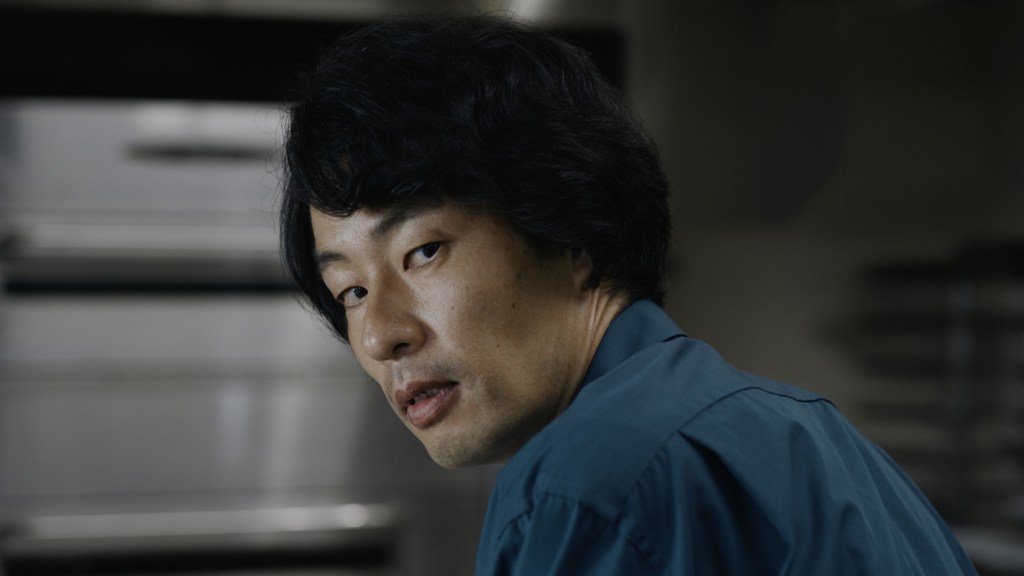
Paula Mermelstein Costa: An important part of Chime is set in a culinary school – which we soon realize has great potential for violent scenes with its raw ingredients and sharp knives. How did you came up with this setting?
Kiyoshi Kurosawa: There is no great meaning to that, setting this location within the culinary school. But, you know, as you’ve already said, in the school, you have all the tools, the knives and everything, lying around. It is also a space which is cut off from the outside world in a way. And you have this very clear power relationship between the teacher and the students. I chose the classroom because it was easy to understand and visually interesting, as murders and suicides occur in such situations. Visually, it was a great location because it was very clear and easy to understand.
PMC: I also find it interesting that these characters are doing very bloody, gory work, every day, in the kitchen, but it’s as if that’s dormant, that they don’t think about it very much. And that relates to some of the plots of your other films, such as Cure, where murder is also practiced by people who live rather mundane lives and don’t think about it. It’s as if this feeling lives inside all of us in some way. Do you feel like that’s one of the points of horror stories, to bring those feelings to the surface?
KK: I believe it lurks within all human beings, but it usually doesn’t surface. People who commit murder are rare. However, the trigger, whatever it may be, is incredibly important. For some, it could be a very random, simple trigger, while for others, it might be something that has been building up for years and years. When a truly unfortunate trigger occurs, I think people might easily resort to violence.
In terms of the story, I believe the main character starts fearing crossing three lines. The first is the line of societal law. Those who cross it end up getting caught by the police. They start fearing the police. Another is the fear of doing it again. It’s about morality. Once you step outside the bounds of “thou shalt not kill,” you might end up killing again in a similar situation. You might end up killing your own son, stepping outside the line of morality. The last one is conscience. Having killed someone. This one is quite straightforward, as it involves the fear of the ghost of the person you killed. That’s conscience. When these three lines are crossed, the fear of these three lines suddenly surrounds them. I crafted a story with this structure in mind.
Finally, although these three lines, these three fears, may not be something people consciously think about in their everyday lives, by committing acts like murder, humans come to understand this kind of confinement within these three limitations. Therefore, in the end of this film, though it may seem highly immoral, I wanted to conclude the story with the impression that he took a step towards overcoming these lines, towards breaking free from this fear.
PMC: There are many theories that say that horror movies tend to have two different narrative modes. One, would be the narrative itself, the story progressing, and in the other the narrative would be put on hold so we can experience that other instance, other kinds of moments. I was wondering if you see it that way, such moments as that one in Pulse when the ghost is coming out of the shadows. Do you think that narrative is a bit on hold so we can experience that moment?
KK: Yes, sure. I’m not sure if that answers your question, but depicting ghosts is always a challenging aspect that requires a lot of creative thinking. It can greatly influence the narrative. In other words, the question arises of whether the ghost exists there as a tangible entity or not. It’s a crucial aspect that plays a significant role.
Generally speaking, there are various ways to approach it, but until a certain point in the story, the ghost may not actually exist and could be portrayed as a hallucination or illusion seen only by the protagonist. This means that although it may appear as if the protagonist sees it and it’s there, in the next cut it may no longer be present, leaving the expression limited to being seen solely from the protagonist’s perspective. While many films stop at that point, I usually go one step further. Initially, the protagonist may perceive it that way, but gradually, the perspective is broadened to suggest that the ghost truly exists objectively. This would change the shots we take; it’s not just the protagonist seeing it, but it’s actually there from an objective viewpoint, visible to entirely different people, and in some cases, if approached, it could even be touched. The presence of the ghost is gradually solidified as a tangible entity, making its existence more and more certain. The narrative mode also changes accordingly as the story progresses. That is how films like Pulse were crafted.
PMC: Your films have this very material, tactile, quality to them. They explore different textures, in both sound and image. Abstraction seems also really important, this nothingness or darkness or even noise. Is that something you think about before the shooting, or do you work through it during the shooting?
KK: This is a very interesting question. There are many ways in which you can do that. For me, I would say the most important thing is the location, the place that we are shooting, because when I’m working on the screenplay, I don’t really have this concrete idea of images and sound. Usually, before the shooting, we look for the locations where we want to do the shooting, and then it’s by intuition. I know this place is just the right place to shoot this scene, because you can really imagine a lot of things here. And, as you mentioned, it’s not just about what’s visible there, it’s not just about what’s in the frame. I can imagine what’s going to happen outside the frame. For example, if there’s a window, I can imagine what’s going to happen outside the window. If there’s a room in the back, just by making it dark and mysterious, it sparks the imagination about what’s in there. It’s about finding a place that sparks the imagination of the viewers. Everything starts from there.
PMC: Your work always seems very aware of film history. Is that something important to you?
KK: I’m always drawn to the historical context of films, or truly classic masterpieces that have been filmed in various ways in the past, while always referring to them as a reference and aiming for that. I want to create works that are firmly rooted in the history of cinema. Of course, what I’m making is new, so I have to surpass that, but in order to surpass it, I always think I need to understand what it is first and aim for it from there.
I’d like to add that one dilemma I always encounter here is, when trying to base a work on a film from the past, how far back in the past should we go, and which work should we base it on? Even though it’s in the past, the history of cinema is quite clear in terms of when it was born and how it evolved. If we want to go back, we can really go back to the very beginning. It makes quite a difference depending on where we choose as the foundation. For example, when we go quite far back, there’s no sound, so it becomes a silent film. Do we go all the way back to silent films, or do we decide that sound has been present from the beginning? A major choice here is whether to go with black and white or color. But once it starts to differ, depending on where we go back to, our stance and even own current stance can vary significantly. That’s the difficult part.
PMC: Some of your films remind me of sci-fi Hollywood films from the 50s. Like It came from outer space, The thing from another world, Invasion of the Body Snatchers. I was wondering if you like this type of film, if that’s a reference in some way.
KK: I like them, but I’m not sure if I’m influenced by them. Maybe a little. I would say I was very strongly influenced by the horror movies of that time. One of the major themes of sci-fi movies from the 50s and 60s was the end of the world, humanity vanishing – and you don’t see that so much in horror movies… I rarely make science fiction movies, but I do make horror movies where civilization ends. In films like Pulse, Cure, I also pick up themes like this. I often make stories that end up going to that kind of place. So I guess I could say that, rather than horror, it may be the influence of these sci-fi movies from the 1950s and 1960s.
PMC: I was wondering how these different types of technologies enter your stories; the CCTV camera in Chime, the internet in Pulse, the daguerreotypes, films, all this old media and new media.
KK: I think about it to some extent, but I don’t know if there is a deep intention behind it. Since movies themselves are made in a form that is precisely a fusion of old and new technologies, I’m naturally interested in the stories that deal with it. The fascination with new images or new communication tools and, on the other hand, their horror – movies tend to be interested in these things inadvertently. I find it intriguing when movies handle this in visual storytelling.
PMC: I’ve seen that you mentioned in a lot of interviews how you were influenced by the work of Shigehiko Hasumi. I was wondering what is it about his vision in particular that interests you?
KK: I’m impressed that you are aware of that. Yes, Mr. Shigehiko Hasumi is a film critic that taught me about cinema when I was a university student, and he had a very strong influence on me, not only in the realm of movies but also in various fields, including ways of living. That influence remains strong even today. Without a doubt.
In simple terms, what I learned from Mr. Hasumi about movies can be summarized in two points. First, when watching a movie, truly watch it, truly listen. Instead of solely focusing on deciphering the story, free yourself from that and truly see what’s being depicted, what’s visible, and truly hear what’s being conveyed. It’s about seeing and hearing. Refining this sense and not being dragged solely by the story. That had a significant impact on me. Secondly, movies, whether you are watching, making, or even just talking about them, are something that a single human dedicates their entire life, their entire being, to pursuing. These were the two main lessons.
 LIMITE