Throughout almost three complete decades, Hong Sang-soo has shifted the course of his cinema several times, focusing on his own model and progressively reducing it to what he deems essential. At one point, he became known primarily for his attention to narrative structures, with story mirroring (Right Now, Wrong Then), confusion of appearances (Yourself and Yours, In Another Country), chronological shuffling (The Day He Arrives, Hill of Freedom), different points of view (Oki’s Movie), and other similar techniques, often exploring comedic and absurd situations in the interaction between his characters, under emotions frequently amplified by alcohol. Hong seemed to be the only filmmaker in activity who knew how to start from a naturalistic situation, create a heated discussion, and resolve it with a disconcerting sense of humor; traversing an entire dramatic arc in a few seconds and moving on to the following scenes that sought to reinterpret what we took from that initial impression.
The comedic aspect in his films came from Hong’s ironic detachment towards what was lowest, his characters lived in the most heated way possible, but always within the limits of their daily habits – romantic relationships with students and coworkers were a recurring theme – which endowed the intensity of their emotions and concerns with a ridiculous and banal aspect. His characters were excuses for a series of distinct behaviors, whose narrative developments exposed their frivolities and ephemeral relationships, as well as their capacity for redemption and eventual generosity. The moral aspect, which still persists in Hong’s films, presented itself as a denial of morality and no dilemma ended with pacification. In the universe of his films, each attitude presents a dilemma between pleasure and embarrassment.
For Hong, telling these stories was an attempt to resolve the problems he was creating throughout the filming process. Hong took risks, acted impulsively, invented unforeseen situations, and gave the impression that, in the making of the film, he found himself in the same situation as his protagonist, often wrapped up in a case from which he needed but couldn’t escape. From there came the structural solutions, as well as the presence of dreams, whose scenes carried the same weight as reality. His film was thrilling because Hong was able to gather a small team, some actors, and, in a few days and with little money, make a feature of good filmic ideas, which drew their power from this compression, often expanding and creating new parallels with the aesthetic universe of his previous movies.
In the two restaurant scenes in Right Now, Wrong Then (2015), when first the man lies to be with the woman and, in the second part, tells the truth about his family and the impossibility of being with her, Hong may have reached a certain pinnacle of his filmography, as it is simultaneously his funniest, most dramatic, and structurally fundamental scene, as it is the point from which the two narratives of the film diverge. Right Now is a synthesis of his concerns up to that point, and the repetition of events in its second part constitutes a limit-gesture in relation to everything Hong had done before: making the same film twice, presenting both parts in sequence, and obtaining two distinct results. There is something in this sense that could not be repeated, which relates to a radical way of facing one’s own film, and this second part of “Right Now,” precisely, gives indications of a dramatic turning point in Hong’s filmography, when the cynical protagonist, present in all his other films, decides for the first time to be honest.
Gradually, Hong’s cinema has changed since then. More significantly, narrative structures have lost their centrality in the construction of stories, and these stories have ceased to have, in general, the unexpected aspect that previously characterized them. The conception of structures used to be one of Hong’s main resources because it effectively shaped the course of his stories and allowed him, from some basic elements, to dispose of variations and developments on situations that, in isolation, would seem trivial.
In Hill Of Freedom (2014), the structure presents itself as a somewhat more evident and didactic solution, illustrated by the film’s first scene: a character searches for a set of letters in the mail, letting them fall and scatter; then, he reads them out of order, giving rise to the film’s irregular chronology. His next feature, Right Now, Wrong Then, is linear until the structural solution emerges in the middle of the film, introducing a second part that entirely remakes the first, with subtle variations. In Yourself and Yours (2016), Hong no longer works with mirroring games as a structural datum, but this is posed in a question about the figure of the female protagonist: whether the appearances of the same actress are necessarily those of the same character; if she lies about not being who she is or if she is just mistaken for someone else by others.
From On The Beach At Night Alone (2017), even this type of conflict, based on the confusion of appearances, ceases to exist. The two-part structure (and its spatial displacement) is a simple ellipse, although the “kidnapping” of the protagonist in the last scene of the first part implies a justification for this transition, without relation, of pure nonsense. Between the parts, the conflict remains regarding the media scandal in which this character finds herself involved, a fictional data that reflects the controversy surrounding Hong and actress Kim Min-hee, who plays the film’s protagonist, at that moment, shortly after publicly assuming their extramarital relationship, in what is one of their most directly autobiographical films.
The last time Hong explored a complex narrative structure was in The Day After (2017), in which the owner of a literary publishing company (Kwon Hae-hyo) hires a new assistant (Kim Min-hee) to replace his old one (Kim Sae-byuk), an ex-lover who abandoned him and the job. His wife (Jo Yun-hee), knowing about the case, goes to the office after her, not knowing that who she meets is a new person, who is on her first day of work and barely knows the man. From these four characters (the editor, the assistant, the lover and the wife), Hong builds a story based on different temporalities, concentrated in just one day, always returning to the same spaces and generating a series of mirrorings in each dialogue, always in combinations of alternating pairs or trios, in which the man’s cowardice appears as the most recurrent motive.
At the office, Kim’s character excuses herself to go to the bathroom; there is a cut and it is the lover who leaves through the same door, talks to Kwon, they arrange lunch; a new cut and, walking down the street, Kim turns the corner next to the man, right before they arrive at the restaurant. Everything that happens in the present with Kim has already happened previously with the other character – as, at the beginning, in the man’s journey from home to work, we cut from a shot of him with his lover on the subway to another of him alone – but these are not about repetitions, about seeing the same scenes twice with different actresses, but about establishing a linearity in which the “flashback” scenes (if they can be called that) fill in the gaps in the narrative of the present.
Later on, after the argument between Kim and the wife in the office, the latter leaves the building and we see the facade with the door closed from the outside. There is a cut to an identical shot of the same location, in a different light, which denotes the temporal ellipse, and the person who arrives this time to try to enter the office, already closed, is the lover. We are no longer sure if this passage is a new flashback or if it actually occurs after what we saw before, in a simple continuity from day to night. Other shots follow the lover walking, while Kim and the editor go to eat at a restaurant again. At one point, the man asks permission to smoke a cigarette and the next shot shows him meeting his lover on a sidewalk. A new flashback, like all the others? A pan, in the same shot, reveals Kim walking in the distance until she catches them together, when, for the first time, the lover’s presence will be contextualized in the present time. Next, the editor fires Kim to give the job back to his lover.
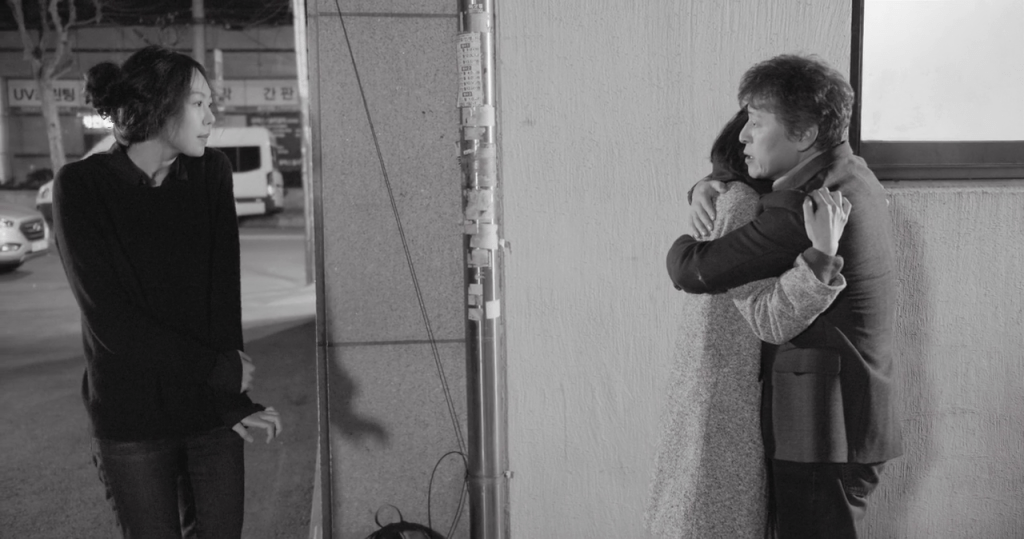
In The Day After, the character of the susceptible and insecure man, who creates unnecessary problems for himself, is still there, with the same defects as before. However, the introduction of this other type, who stands apart from this vulnerability, offers him the possibility of a more positive way out, another philosophy to follow. In the passages with Kim, a line of spiritual nature stands out, in a character who apparently finds fulfillment in life and tries to pass on a lesson of serenity, as in the restaurant scene where she talks about what she believes in life and questions the man about his reasons for living, something that had never been said directly in Hong’s other films. It’s still early, however, and Kwon will make the same mistake as before, he won’t resist staying with his lover, while Kim’s character will move on with her life. The film is, above all, about the counterpoints between these two personalities, which still guarantees stimulating discussions, but it will in some way be a farewell to this classic character from Hong’s films – and counterpoints, in general.
At the end, as an epilogue to the story, Kim enters the publishing house again, appearing to visit it for the first time, and sits down to talk to Kwon on the same sofa where the first conversation between the two took place at the publishing house, under the same frame, repeating almost exactly the same questions and answers. Little by little, we discover that this is not a repeat of the first day, but a reunion, and we realize together with Kim that the man doesn’t remember anything that happened, something he only recognizes later. He says that his lover left her job a month after the episode, that he returned to the house to take care of his daughter, and it seems that there he found the reason for living that Kim questioned him about in the restaurant. It’s a redemption for this character and, even if briefly, Kim was a moral example for him.
In Claire’s Camera (2017), the idea of redemption and change in behavior of its characters defines the entire film: Claire (Isabelle Huppert) takes photos of the people she meets in Cannes, during the Festival, and their personality changes as a result. Without subtleties, this is presented to us literally, when the protagonist says: “when I take a photo, people change”. It is an attribution of external information, but which generates a recurring motif throughout the film, in the successive photos taken by Claire and in the relationship that follows with the photographed character, generating a minimum of cause and effect.
This “minimum” is also present in The Novelist’s Film (2022), the most well-resolved of his films after The Day After and Grass: the novelist (Lee Hye-young) meets an actress (Kim), they decide to make a film together , they choose locations and, after a big ellipse, the film is shown. We therefore follow the motivation, making and final result of the film announced by the title and the narrative follows a linear chronology, in which the characters pursue a defined objective. The idea of the film to be made and the search for a way to make it gives rise to a narrative movement that is not so evident in his more recent films and the strength of The Novelist’s Film lies in the expectation that is created, little by little, around what this film could be. All the dialogues and walks that present the gradual conception of the film take place in a single day and their nature is suggested in different scenes, pointing either to a way of filming, to locations in a park, to the story that should take place, loosely defined parameters that allow for the presentation of an unexpected material.
At the press conference for The Novelist’s Film at the Berlin Festival, Hong says that one of the reasons for doing so was an attempt to compare some material he had already filmed with something staged with the actors, to see how these two “textures” would relate to each other in the film. The entire narrative that we follow, therefore, arises from the need to establish parallels to fit this 1 or 2 minute excerpt of spontaneously filmed material, preparing the terms that naturalize its presence on the screen. The resource itself is not new, the film within the film is something Hong has done other times (most famously in Tale Of Cinema), but never exactly like he does here. In this material, which appears in the final minutes, filmed handheld by Hong himself, whose voice we recognize out of frame, on a walk with Kim (and her mother), we recognize the places we had already seen in the park before, now under a completely different register, in which the images are not fixed on a defined motif and, at the end, there is a transition from black and white to color, present only in this final section.

The fitting of this fragment does not occur in an exact manner – it is important to remember that this would also be just a part of the novelist’s film –, appearing on the screen only after the actress has left her projection. This displacement makes more evident the way in which Hong tensions a fictional production with this casual register; that is, how the filmmaker concludes the fictional episode and, only after it, inserts the documentary register, which passes for fiction. At this moment, the simplification of his cinema and its movement towards a more personal subject is directly faced from the material, around which the film’s narrative is formulated, not just from the subjective speeches of its characters.
Over the course of a series of reunions and casual conversations, the novelist speaks successively to a filmmaker (Kwon), an actress and a poet (Gi Ju-bong). Each of them will self-criticize their work, reviewing the paths they had followed in recent years. It is the pretext for – as was common in his filmography, when Hong frequently introduced types who emulated his own lines in interviews – the filmmaker to say that his work has changed in recent years and that he no longer feels the same compulsion he felt in making films, wanting to solve life’s problems first. Later, the novelist tells the actress that she feels she has gone too far in recent years and has gone too far into a kind of “sensitivity” that she previously thought was interesting to explore, but now believed was becoming something false. “I can feel myself exaggerating”, the novelist says, “as if I had to keep inflating small things into something significant.”
In 2017, Hong was also talking about a new “sensitivity” regarding his collaboration with Kim Min-hee, which begins precisely in Right Now, Wrong Then. [2] This collaboration is decisive for the change in his recent films and the period that made his work more popular, with the recurring participation of Kim, who soon becomes a figure of easy identification for Western audiences and of direct association with Hong’s films – its other actors are, in general, stars of commercial cinema and Korean TV, little known here. This collaboration, however, implies a problem in adapting Hong’s narrative resources, as he no longer tells stories with mostly male characters and has at his disposal an actress whose appeal is not exactly dramatic, but whose expressive quality is more related to her posture and mood. There are no great moments of dramatic acting in her appearances in Hong’s films, but Kim’s presence imposes itself as a mirror, as a screen for other performances. Kim’s character is always out of conflict, she is rarely disturbed by other people’s dilemmas, but she is like a thermometer of what is happening around her, observing and commenting from a certain distance on the behaviors, especially of her male peers.
In Grass (2018), Kim Min-hee plays a character sitting in a cafe, writing on the computer, while observing other people around her, almost all of them couples discussing their relationships. We have little context in relation to each of these characters and, more than telling their stories, the film wants to portray a moment in their lives, in which feelings emerge through their dialogues and small clashes. We always return to this quiet figure, the counterpoint to the emotions of all the others, and her centrality generates a question about the relationship between what she writes and this environment. It remains unclear to the viewer whether what happens around her is the reality she writes down, whether it is the projection of a fiction she created or whether, simply, this simultaneity is just a coincidence. In any case, Kim’s character offers a minimal structural point to the film, establishing a link between a priori disconnected scenes and stories. In the final scene, some of these characters go out to smoke on the cafe’s balcony and alternate one by one in the center of the image, as the previous one leaves the frame, in what is one of the last great moments of staging in Hong’s filmography.

*
Hong, at 64 years old, has passed the drinking phase, is approaching old age, sees and reflects on life with different eyes. The change in the characters’ behavior towards life is not something occasional, but has become a theme in the most recent films. This relates to Hong’s recent statements, in which he talks about personal maturation, linked to moving away from his old habits and the presence of a much stronger religious feeling. [3]
Hotel By The River (2018) manifests this through the poet played by Gi Ju-Bong, who senses his own death and calls his two sons to meet him at the said hotel. His attempt to get closer is frustrated and, throughout the film, he is unable to tell his sons why he called them, constantly running away from the two, who are waiting for him in a cafe. Only at the end, does he have a conversation with the two other characters we see in the hotel, two women, with whom he finally identifies and talks about his own work, reciting one of the last poems he wrote. The next day, his sons find him dead in the bathroom of his room, screaming desperately while the women sleep peacefully in another apartment. [4]
Notably, his films have become more melancholic and “contemplative”, but it is a melancholy in the background, where questions about being alive, illness, old age and death are rarely expressed directly, discussed by his characters. Anyone who has seen his previous films will remember how these themes were already present, along with sex, fights and vomiting, through taciturn or desperate protagonists. In 50:50 (2013), a 1m35s short for the Venice Film Festival, Hong presents an extremely concise, comical and cruel scene, with a man who uses his wife’s terminal illness to flirt with another woman next to him. Without this disconcerting aspect, today Hong’s films are more comfortable for the viewer, who is also no longer confronted with ambiguous stances and complex narrative structures. His film is linear and naturalistic, like much of the cinema around him, in the exhibition spaces where it is present. It no longer represents that point outside the curve and reveals itself to be adapted to a context of reception that is also easy and light, in which the recurrent reaction to animals, food and objects present in the scene is a reflection of a lack of interest in the composition of the whole and in which the viewer’s gaze focuses mainly on casual details.
Hong continues to make narrative cinema based on characters, but deliberately excludes the external dimension of the conflict, as it was previously characterized by the tension within the scene, and now concerns, mainly, an internal state of these characters. What is required of the actor is no longer the expansive gesture, but the serenity of speech. No longer the alcoholic and erotic episodes, the conflicts of character and attitude, but a turning to oneself, in situations apart from the hustle and bustle of everyday life. In rough terms, it can be said that the same situation is repeated and gives rise to most of the dialogues that make up the film in this new regime: in general, one character presents a new object to another, be it a building, a car, a person or a drink, and immediately discuss their characteristics, as the first acts as an expert and the second listens attentively, until at a new moment another object appears and replaces the first’s place as a topic of passing discussion. Frequently, his characters keep their intimate conflicts behind a mild behavior and trivial conversations, just passing the time, without reacting vividly to situations. Hong seems to want to show his characters’ difficulty in being honest with themselves and others, but their passivity on stage ends up being confused with the passivity of the film itself, which conforms to banal appearances, without elements that expose a critical look at these attitudes, adhering above all to the emotional state of these characters. [5]
The Woman Who Ran (2020) and In Front Of Your Face (2021) are both centered on an introspective protagonist, who has a series of reunions with estranged friends or relatives, in which she listens more than she speaks. In the first film, the character recently ended a relationship; in the second, she is terminally ill. The reasons for her wanderings remain hidden throughout the films, occasionally appearing near the end – especially in In Front of Your Face, when the revelation about the protagonist’s health takes on the air of a plot twist. Only then does the question of the imminence of death emerge, as well as the new dimension that those small dialogues and meetings can gain, the consideration of events and objects, in the character’s remaining moments of life. In this case, this revelation requires a retrospective look at the film, in which the viewer notices everything that happened before, tries to see the situations with the same eyes as the protagonist, now aware that these could be her last moments. The issue is that, in practice, the film offers very little to its viewer, who, despite the film’s intentions, does not share the same point of view as its protagonist.
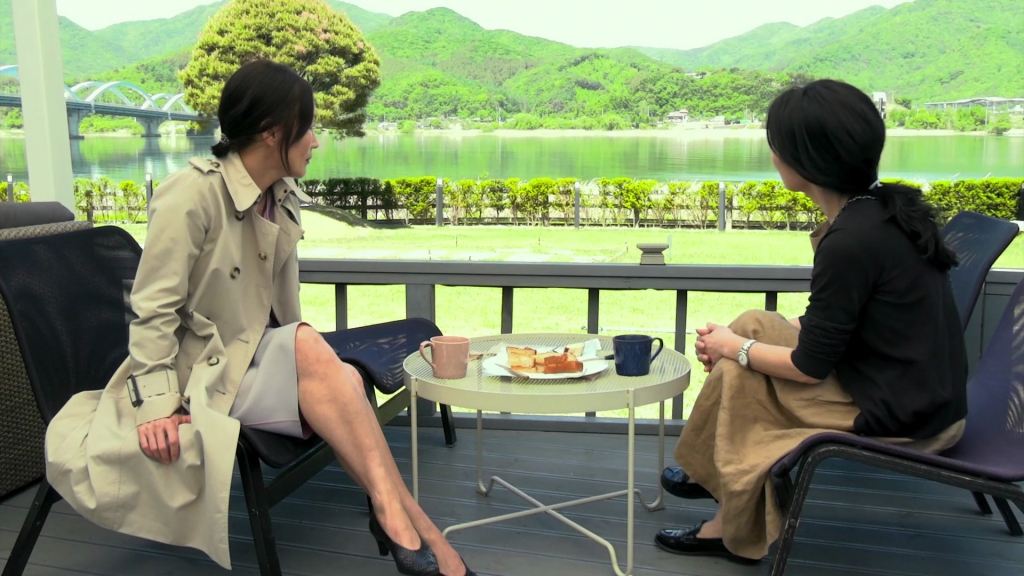
Introduction (2021) brought the conflict between different generations to Hong’s most recent cinema, following the dilemma of a young, insecure character who wants to become an actor, but seems more forced to make certain choices by those around him than moved by his own will. Walk Up (2022) and In Our Day (2023) are also based, the second mainly, on the relationship between adults in a midlife crisis and young people aspiring to their professions, who ask them for advice. Unlike the movements of the protagonists of previous films – in The Woman Who Ran, Kim Min-hee makes successive trips, in In Front Of Your Face, Lee Hye-young has a long solitary walk and, in Introduction, Shin Seokho travels from Korea to Berlin and back to Korea – Walk Up and In Our Day are set in fixed locations – the same building in the first and two apartments in the second – and seem more interested in the relationship between the group of characters than in the individual drama of a protagonist.
The temporality of these two films also has a peculiar aspect, as there is a sense of absolute stagnation in them, in which the story is in a certain way suspended, averse to the passage of time and the very idea of narrative movement. Between the characters, these encounters seem to mainly characterize moments of boredom and embarrassment, which last indefinitely. Among the few events that happen in In Our Day, for example, is the disappearance of a cat in the house where the actress, played by Kim Min-hee, is staying, and a return to drinking by “poet Hong”, played by Gi Joo-bong. The last scene of Walk Up plays with this temporal dimension: the episodes that we follow in the life of the protagonist (Kwon), presented between ellipses, which suggested them to be months apart, seem to have taken place during the minutes in which his daughter went to the market to buy bottles of wine, meeting again in the last shot with a bag in hand and resuming the dialogue as the two left off in the first sequence of the film.
These details, however, do not constitute the substance of Hong’s work on these films, being secondary aspects of a strict concentration on the content of the dialogues. At first, both may resemble The Day After, a film that also takes place in a few locations and a restricted set of characters, but the way Hong uses these elements is opposite. While in Walk Up and In Our Day one perceives a certain aspect of chronicling the events, in The Day After the opposite occurs, one feels that there is an internal pressure, that the film is constantly tensioning expectations and, above all, the bookstore space itself is the driving force behind the dramatic events, also changing its characteristics depending on the episodes that take place there: at first, it is the harmless place of work; later, it is where the extramarital affair is exposed, invaded by the couple’s fight; Finally, it is the scene of an ambiguous reunion between the two characters. Wherever we look in The Day After, we will find a dynamic that attributes density to narrative time and space, something that the other two films no longer propose or are incapable of doing.
In the first scene where Kim Min-hee and Kwon Hae-hyo talk in the restaurant, as an extension of the initial job interview, we encounter for one of the last times what was the most characteristic element of Hong’s language: the use of zoom and of the panning over the long shot in the dialogue recording. Both protagonists are sitting at the table, a question is asked by Kwon, in the foreground, the camera pans to Kim, she gives a long answer and the camera returns to Kwon, who reacts and briefly comments on her speech. It’s a simple and even natural movement, but the camera participates in the scene, directs the gaze, alternately shows who speaks and who listens. Seeing Kwon’s reaction only after the end of Kim’s words, and not during, preserves the strength of this moment of silence, highlights how those are different words, that he is not used to hearing. His expression does not compete with Kim’s speech within the shot, but appears later as a consequence of it.
In recent films, this dynamic is excluded and we see simultaneously who speaks and who listens, in a long general shot, without the creation of new dramatic emphases. The monotony they present, absent variations of emotions and episodes, is the opposite of what marked their previous production, when structures and technical resources sought to define, expand, emphasize scenic elements – maintaining, of course, a margin of ambiguity from which conflicts arose. Thus, Hong only continues a “reduction” of his resources, just when his new dramatic ambitions seem to require a different depth, another language than just the dilution of the previous one. At this point, it also becomes clearer what happens in In Water (2023) and the much-commented blurring of its images.
As in The Novelist’s Film, here we also follow a director trying to make a film, along with an actress and an assistant. What Hong shows is above all a character who doesn’t know what to do, uncomfortable with having to invent a reason for the others to have accompanied him there, as well as what the experience represents for him: the money spent, the embarrassment, the general anguish, and, finally, the desire to kill oneself and the somewhat ridiculous idea of the film to be made, ending with a scene that links this film to Introduction and makes these two the only recent films in which Hong laughs again at his protagonists.
When looking for locations, the other two repeatedly praise a small yellow flower, which we can barely see, highlighting its beauty amidst the stone wall from which it emerges. The director’s response says the opposite of them: “This place is good, it’s not very pretty.” Among all of Hong’s films, perhaps none was shot in a setting as picturesque as In Water: a tourist coastline, with a beach with crystal clear water, where almost any shot shot would easily become a postcard. After the preparation stages, we see the filming itself, which here is not followed by the scenes filmed by the protagonist – we will never know if their images would also be blurred, if they could contrast or complement Hong’s shots in some way.
Obviously, the blurred images do not represent a technical sloppiness, but a significant gesture of a certain search for the anti-aesthetic, already present in the blurred shots at the gas station in Hotel By The River, in the saturation of the images in In Front Of Your Face or in the exaggerated contrasts from The Novelist’s Film. Since he began to be his own photographer, in Introduction, assuming all the technical functions of his films with the exception of capturing direct sound, the images in Hong’s films have manifested an increasingly rudimentary appearance, following the simplification by which what is present on the screen is also going through. Although it may be strange at first, the blur continues to be present in In Water as a naturalized element, almost like an adorned way of showing the same motifs present in other films, maintaining the other aspects of the image: long, fixed, general shots, with characters detained in dialogues. [6]
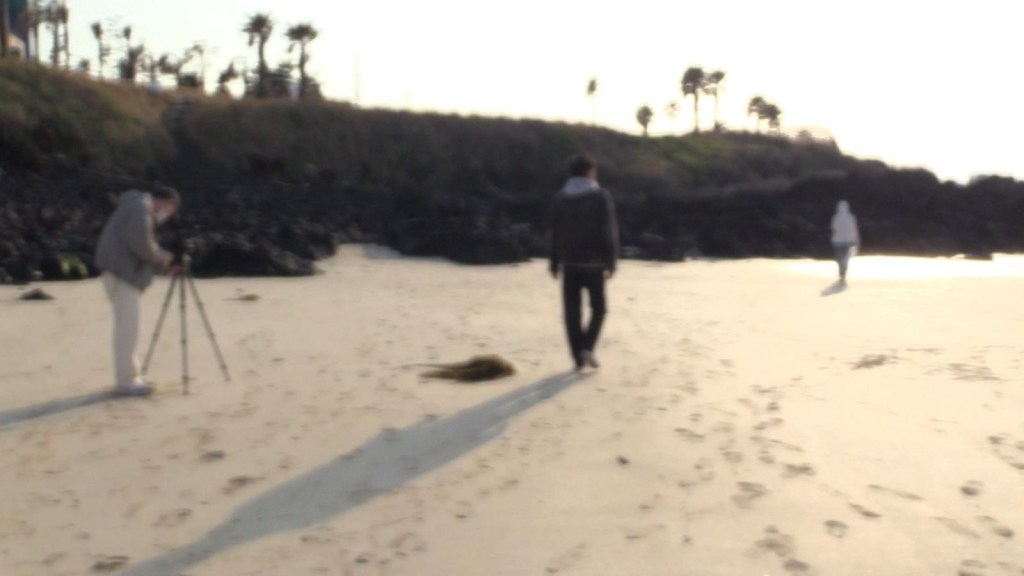
Hong today seems to believe that sensitive appearances have an autonomous value and are available to the spectator so that isolated elements can be captured by them. There no longer seems to be anyone behind the camera mediating what should be seen, promoting cuts, guiding the narrative, establishing parallels. The film presents itself under a certain pretense of casualness, as if it happened spontaneously and Hong intended to erase his presence or any ordering consciousness. In the blur of In Water, the figures lose their definition, the film aims to take on an ethereal aspect, dissolving their materiality. Ultimately, what this recent treatment of his films represents is a certain impossible and senseless quest to make a formless film, contrary to what characterizes his previous work. [7]
In Water seems to be the end result of a process of erasing the figure of the filmmaker as we knew him in previous decades, and it is significant that Hong, who throughout his filmography portrayed filmmaker characters, shows here for the first time one of them struggling with issues about a film, representing scenes of its making. According to his recent statements, Hong has concentrated all his work on the production phase, trying to finish the films during filming, keeping the minimum of adjustments to be made later. The music, recorded in direct sound, no longer requires mixing; In editing, the shots are still arranged according to the filming order and the sound is simply synchronized with the images, without needing much more adjustments. The gesture of treating the film as an instant, without thinking too much about what you are doing, trying to finish things in a single impulse, refers to a certain chronicle aspect to which his films have come closer, increasingly manifesting their momentary inspirations, passing very discreetly through the elaboration of characters that are vehicles for Hong’s private reflections. [8] [9] [10]
Hong seeks other ways of expressing himself, pursues this new “sensitivity”, but his recent features express above all dissatisfaction, the anguish of not achieving it – or, remembering the dialogue in The Novelist’s Film, an anguish of not going beyond this sensitivity. His ambition to address certain themes is today much more evident than it once was, but the consequence of this is that the visual and thematic expressions are separated in these more recent features: the tension between what is seen and what is shown disappears from the film, images are summarized to the function of illustrating speech, which becomes their main feature. Finally, the poetic synthesis that used to characterize his narration disappears.
Ten years separate The Day He Arrives (2011) from In Front Of Your Face, also significant of the transformation process that Hong’s cinema has undergone, but the recurrence of the same bar/restaurant frequented by the characters, called “Novel” brings them together perhaps in a unique way throughout his filmography and also explains the nature of this transformation and what remains between these moments.
In the first film, whenever the characters arrive at the place, the same situations are repeated: as if they were there for the first time, they seem to not know each other, repeating the same dialogues and attempts to get closer. Starting from a realistic assumption, the film mischaracterizes the sequential, natural apprehension of the episodes, in which the narrative is formed from the re-elaboration of situations with minimal changes in details, creating a conflict in the very form of the film and complicating its story. If, on the one hand, we can think of alcoholic amnesia as a justification for this, the gradual and subtle transformation of appearances, dissolving the impressions we formed before, makes it impossible to perceive continuity between scenes and distrust arises as to whether the filmmaker is replicating exactly what he has already done or whether something new will emerge from it – and, most importantly, what, when and how.
The recurrence of the same location in the second film highlights the change in Hong’s work in the intervening decade. As in almost all recent films, the narrative solutions in In Front of Your Face no longer involve the configuration of structures and parallels, but a linear progression of the story. In this sense, the bar/restaurant filmed is just one of the other locations in the film, and its peculiarity is that it is the place where the protagonist (Lee) meets the man with whom she finally opens up (Kwon). Her presence is affirmed under a realistic assumption, it is the space conducive to a fortuitous event, as the point of arrival of her characters’ destiny. In The Day He Arrives, it is the starting point, structural and poetic synthesis of the narrative: it is the space where fiction happens.
Matheus Zenom
Notes:
[1] In issue 8-9 of Foco – Revista de Cinema, I published a long study on Hong Sang-soo’s films [in Portuguese], completed between 2019 and 2020, describing his production method and cinematographic resources. I recommend that it be read before the present text, which continues where it left off, following his most recent films and seeking to define a change that has been happening in his cinema, not just since The Woman Who Ran (2020), as indicated there, but since the mid-2010s.
[2] “Kim Min-hee’s character [in On the Beach at Night Alone] says something about this, about praying to God. Except for that character, I’ve never written someone who says this, my attitude, directly. I was being careful. But now I’ve changed, I guess, a little bit. With Kim Min-hee I thought, ‘Maybe it’s okay to say these things directly’.” In an interview with Darren Hughes, published in Notebook, on November 15, 2017. Available at: https://mubi.com/pt/notebook/posts/there-are-mirarcles-a-conversation-with-hong-sang-sound
[3] In the debate after the screening of In Front Of Your Face at the New York Film Festival, in 2022, Hong responds when asked about the protagonist’s religious feelings: “I respect what I call ‘what is given’ instead of what is ‘search and found’. I try to be open and something always comes up and I just respect that. Her remarks, monologue and prayers came up in the same process. Of course, it reflects something going on inside me. I’d like to be careful to say about this very very very personal thing, so I should just stop”. Available at: https://www.youtube.com/watch?v=HzRcBUZ32kY
[4] This treatment of death, which ends in a dramatic way, is not the only difference in relation to the other films he had been making until then: Hotel By The River is also filmed entirely with a handheld camera and in it we find some scenes of flashbacks motivated and accompanied by a voice-over narration from the protagonist, using a montage of short shots. Unlike the films Hong makes later, starting with The Woman Who Ran (2020), we also find here an interest in ellipses and parallel montages.
[5] On The Beach At Night Alone is the first of his films more directly focused on the inner state of a character and no longer on the actions and dramatic events that he or she goes through. There, however, at different times the issue that afflicts her, the media controversy in Korea, comes to the fore and is discussed by the characters, until at the end there is the director’s (Hong’s alter-ego) monologue, which spills over onto this whole situation.
[6] The same can be seen in the presentation of the soundtracks, also composed by Hong, which no longer have the melodic aspect of Yeong Yong-jin’s piano, previously a regular collaborator, and today constitute a noisy, obscure sound of notes sparse sounds of a guitar. These songs have no longer been mixed in post-production, but, as we discovered in In Water and in press conferences, they are recorded directly on his cell phone and played back next to the microphone that captures the sound directly from the scene, creating its distinct sonic texture.
[7] It is important to clarify here the difference between chance and improvisation in his films, which are often confused. Hong always gave the actors freedom to act in their own way, as long as they respected “99%” of the words in the written text and did not deviate from the intentions of the scene. His films never stopped being scripted and Hong continues to this day with the daily routine of writing scenes. On the other hand, Hong has always been open to chance in the course of the film, whether in relation to the conception of the scenes themselves or the small detail that appears during filming and has the potential to generate a transformation – the best example of this is the bird scene in Night and Day (2008), as I comment in the aforementioned text from Foco.
[8] In the debate that followed the screening of In Water in the Encounters section of the 2023 Berlinale, Hong spoke a little about how he has been working in recent years: “As much as I can, I want to finish everything on the location. Of course, there are a few things I need to seek correction, but I want to make it minimum. I want all the important decisions made and executed on the location. That way I think I feel I’m alive, I can concentrate really in what I want”. Available at: https://www.youtube.com/watch?v=sdhtrPtabWY
[9] Idem: “More and more the details are coming from my surroundings and closer to the present time. In the older days, I was picking the details from a more distant past. That way it wouldn’t relate to me personality. Now, what I want is basically to go as close as I can to the thing, but never touch it. Because if you touch it, everything is poised. So, you go back just before touching it. That distance is becoming smaller and smaller Now, I can use some details I come up a few days before without ever having a problem in using it in my script”.
[10] We could find, in the short 2 or 3 minute films that Hong says he makes on a recurring basis, such as the excerpt he uses at the end of The Novelist’s Film, a distinct key to his recent interests, something more purely plastic than properly narrative. It is unlikely, however, that this type of material, properly homemade, filmed and edited in a single day, will be available to the public at some point.
 LIMITE