Little over twenty years separate us from Edifício Master (2002), which has long been established as one of our recent classics. Entirely filmed within the titular building, its project is based on interviewing some of the residents within their apartments over the course of a week, in the traditional neighborhood of Copacabana, known for its social complexity and urban agglomeration. Master, the building, seems to concentrate it, and Eduardo Coutinho’s film sets out to see who are the individuals present in this place. What these people have in common, at first, is only the fact that they live in the same building.
The first interviewee summarizes the history of Master, for decades a place of prostitution, but that in recent years, after an administrative reform, became a “family building.” The woman tells us that she spent her entire life in the building, living in 28 different apartments, most of them with her mother. All for a peculiar reason: they decorated the apartments they lived in very well, catching the attention of passing neighbors who admired them and, desiring to move there, sublet the fully furnished places. Mother and daughter continued in the same building, repeating the process with a new space, financially surviving through these successive exchanges.
Master is located in an upscale neighborhood of Rio de Janeiro, no more than a hundred meters from the beach, as Coutinho’s voice-over initially states, announcing the film’s project: “We rented an apartment in the building for a month. With three teams, we filmed life in the building for a week.” Its residents, in general, belong to the middle class, and each of their apartments is just under 50m², all similar in size and floor plan. The aspect of each of these apartments is inevitably an extension of the personality of its inhabitant, presenting distinct decorations: some covered in curtains and heavy fabrics; others with antique wooden furniture; sometimes filled with religious images; rarely empty, with very little or no decoration. There are people who present their homes with more pride, giving a sort of guided tour for the camera, and others who are only seen in a closed shot, without views of their surroundings.
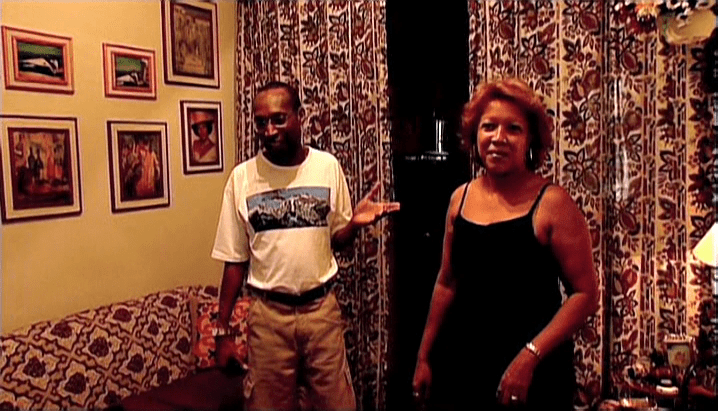
Most of the interviewees in Edifício Master are between 40 and 60 years old, with young inhabitants of the building being rare. Each of them narrates some aspect of their biography, whether previous marriages, professions, or family relationships. In one of the interviews, a man who barely introduces himself already says goodbye and surprises us with the brevity of his presence on the scene. Throughout the farewell, his story unfolds; he remembers the mother who died by his side in Brasília, and here is the destabilizing part of the story, what moves him the most is his gratitude to the employer who allowed him to travel to be with her. The man seems to cry not for the deceased mother, but for the pride of being recognized as a good employee. A similar case occurs with Esther, who says she put on long pants to jump out the window after being robbed but decided not to commit suicide because she remembered the debts she still had to pay.
In most cases, these are common stories, life stories as one could find in other places and contexts, without extraordinary events, but perhaps only in a neighborhood like Copacabana and in a building like Master would one find a similar diversity, gathered within a few square meters. Social institutions, precarious work, urban violence, themes that can be found in any newspaper headline, are discussed there. There is also resentment, pettiness, and cruelty in some of the interviewees’ accounts, which affirm negative images not only of the world but sometimes also of themselves. The neighborhood of Copacabana, like all other places, is only evoked in these conversations. We will not see its streets, nor the beachfront; the windows, when shown, always face other windows.
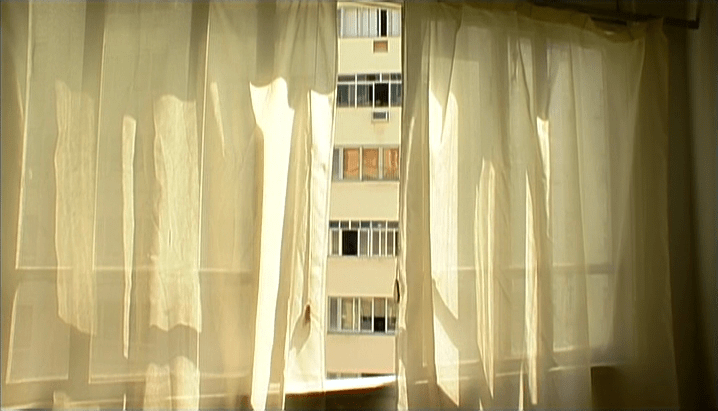
Edifício Master begins with a shot that shows, through the security camera monitor, the team of four or five people entering the building and going up together in the same elevator. A decisive inclusion, reiterated at various other moments, of what is behind the cameras, the filmmaking work, and the reduced team that makes it possible. It is also frequent, here and in other of Coutinho’s films, the moment of the director’s first approach to the interviewee. Each time, this approach is distinct, but generally, the team arrives, asks permission, says good morning, shakes hands, and makes light comments: it is a presentation ritual, an invitation to enter the apartment, the initial greetings, the director’s introduction, situations that occur under different moods according to each interviewee. All with the camera in hand, in motion, until the next shot already shows the interviewee seated and ready to speak. From this cut, the camera fixes the close-up as the standard for interviews, directing the viewer’s attention strictly to the speech and facial expressions of the interviewees, whose names are soon marked in the corner of the screen.

Beyond the personal dimension of each speech, the accounts are enhanced by the similar conditions of presentation of their characters, presented solo, in pairs or trios, always within their apartment, which constitutes a determined block of the film, without reappearing at other times. The editing operates mainly within each particular block, stitching only the speeches of the same character, never crossing between different participants in the film. Edifício Master comprises a mosaic, in which what is said at the beginning may be mirrored in many interviews later, establishing returns and parallels between people and distant parts of the film, through common themes and reactions. The recurrences, therefore, are more surprising, and the tensions between the characters gain strength from their sequential accumulation and the appearance of spontaneity in the unfolding of the film.
In this regard, the choice to maintain, as much as possible, the chronological order of the interviews in the editing contributes a lot; not seeking to group the accounts by themes or profiles of the interviewees but allowing the relationships between their speeches to be projected throughout their duration. In an interview with Contracampo magazine, Eduardo Coutinho clarifies his editing operations: “The Frank Sinatra man […] is the most evident character, somewhat obvious. So obvious that we filmed him last and changed the order because it would be emotional blackmail. In this type of film, that can’t happen. So we put him in the middle of the film. Besides that, we separated two suicide attempts, which were stuck in chronological order, and three who sang because they were one after the other.” [1]
Among the interviewees, there is one particularly interesting for her scarcity of stories to tell. She is the last participant in the film, who has just arrived in the capital, coming from the interior of the state. This young woman, apparently 17 or 18 years old, presents herself as naive, sitting on the floor, and when the team enters the apartment, she extends her hand to Coutinho, asking “who are you?”. Throughout the interview, she mainly talks about her mother and grandfather, who sent her to Rio to go to a college-preparatory school. She has only been in the building for a short time and does not even know her neighbors; according to her, only a few days before filming she was able to see for the first time who was the child that she heard playing and only knew the name. After many emotional accounts, it is significant that Coutinho and his team have left her as the last interviewee in the film, ending the film with a serene character who seems to not have many stories to tell, she has not yet experienced the traumas, the dramatic events, that other people narrate, as if her personal story is yet to be written. “I still don’t know what I want to be,” is the last phrase with which the film ends, with this being the only participant in the film who talks about the expectations of her future life, not the past.
The first interviews for Edifício Master, however, are not conducted by Coutinho, but by his research team, which rented an apartment in the building for a month, getting to know and interviewing some of its residents, in the process of researching participants for the film and then showing the filmed interviews to Coutinho in the apartment where the initial discussions about the possible interviewees and the conception of the film’s cinematic ideas and conceptual mechanism took place. We follow this process in the documentary directed by Beth Formaggini, Coutinho.doc: Apartamento 608 (2009), which closely follows what happens in the production base. There, the director and the team watch these research interviews, whose edited material with the film’s participants is included in the extras of Edifício Master’s DVD, arranging the speeches following the order in which the same interviewees are presented in the film. [2] [3]
In this initial contact, some of the approached residents are suspicious of the filming, they question the reasons for being interviewed, what will be done with these images, hesitant about the presence of the camera and their participation in the film. The interviewers try to find out who they are, listening to their life stories, gradually convincing them to go on and helping to define some of the themes that they could “tell the director” when the actual filming begins. Thus, an expectation is created for when Coutinho will enter the scene, for this special event that will be filming with him, and it is important for the project that he remains distant until then so that the interviewees have a new stimulus to also tell him these stories for the first time. In these initial conversations, we see at the same time the preparation of the piece and the rehearsal with the actors, who, later, will try to convince the director of their performances.
In each interview present in Edifício Master, therefore, we are facing a reenactment. The characters dress and make up for the film, just as the assistants often remind them of lines they had agreed upon in preparation. At the end of some of the appearances, Coutinho questions the performances and asks the interviewees about the reasons for their behavior throughout the speech. “Why didn’t you look at the camera?” he says to Daniela, who reads a poem. “What was the lie you told?” he asks Alessandra, who talks about her life as a prostitute. This last one is particularly special for the course Edifício Master took. At the end of her selection interview, she says that, for the day of filming with Coutinho, she wants to present herself as a sex worker, dressing in character to be more convincing in the stories she will tell. Among the possibilities of her account, she could choose the role of mother, young girl, immigrant, alcoholic, but she wants to interpret this other role, which she says is the “Alessandra of the night.” In Apartamento 608, we see Coutinho’s reaction to the tests he watches; initially uninterested in the middle-class characters and disbelieving the course of the project for most of the preparation, the director gains a new enthusiasm from Alessandra’s presence. In a meeting marked with the team, who were waiting for his resignation, he reaffirms the desire to move the project forward, making his new ambitions clear: “I wanted there to be more invention, more lies. […] This woman is wonderful because she will be theater.” [4]
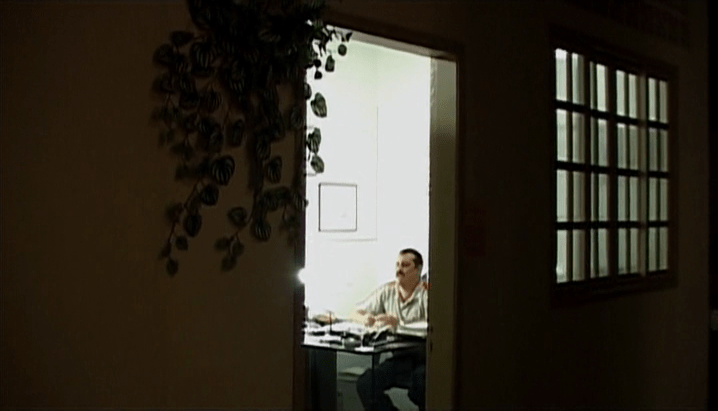
In Apartamento 608, the first interview conducted for the film, when Coutinho finally faces the interviewee, is with Sérgio, the building’s superintendent, who receives the team at the door of his apartment, like the other participants. In Edifício Master, however, the introduction of the same interviewee is done differently, in a shot that begins with the camera in the building lobby, passing through some residents sitting at a table, entering through a door and finding the superintendent sitting behind an office desk, in a completely different environment. It is clear that Coutinho and his team deliberately re-enacted his interview, inserting this character in a context specific to the distinct role he represents in the building, not just another common resident.

At the end of Formaggini’s making-of, there is the filming of perhaps the most well-known scene from Edifício Master, when one of the interviewees sings Frank Sinatra’s “My Way”. At first, however, what plays on his radio is “New York, New York”, but Coutinho interrupts the recording and demands that he switch to the other song. We know that the man sings three times and, after the last one, we see Coutinho excited, exclaiming to the camera of Apartamento 608: “It’s pure fiction! That’s what a documentary is.” Coutinho directs the interviewee as a director of a narrative film would, introducing what he wants from his performance, preparing the emotion he wants to achieve—with success, after all it is the most remembered and commented scene of the film. The vision of its creation dismantles the conventional logic of the documentary as a record of the “real” and “spontaneous” and reveals how Coutinho’s work goes through this type of fictional elaboration, both by the interviewees and the interviewer, even though it is held within well-defined parameters of an approach specific to documentary filmmaking, faithful to the filming situation and aware of the ethical and aesthetic dilemmas of presenting real people, telling their stories.
We follow, through this set of materials—Edifício Master, Apartamento 608, and the research interviews—the gradual discovery of how must this film be like, its formulation according to the delimited context, adapting to the restrictions that the space and the verbal material of its interviewees present: in short, what we see is the invention of a filmic form, in a much more complex work than the label “documentary” may seem to imply. “It won’t be the film I want, it will be the film that will be possible,” we see the director comment at one point. His filming does not start from predefined concepts, does not present itself as a report, and does not seek to prove anything about these people, Copacabana, Rio, or Brazil. “To show the soul of a building, the spirit of a building, the diversity of life in a building. That’s the film,” Coutinho says at one point in the preparation. Only from this foundation do all other questions seem to arise. Among the filmic ideas we see discussed, the actors, non-linear editing, and fiction stand out: some of them present in Edifício Master and others only considered, but all decisive for the possible film to surpass the director’s initial low expectations and equally fundamental for the film that Coutinho really wanted to make, to be completed five years later, called Jogo de Cena (2007).
Matheus Zenom

Notes:
[1] Interview available at: http://www.contracampo.com.br/45/entrevistacoutinho.htm
[2] This research material is available at: https://www.youtube.com/watch?v=kpRCNqjwQ5c
[3] Beth Formaggini’s making-of is also available at: https://www.youtube.com/watch?v=z3OA_n4U4HM
[4] Alessandra, in the end, does not fully keep her promise, as she presents herself dressed in casual clothes and assures Coutinho that she did not lie at all during the interview. The 100 reais she claims to have spent at McDonald’s call this into question, however.
 LIMITE