Júlio Bressane welcomed us into his apartment on March 23rd, accompanied by his grandson João Batsow and, later, his partner Rosa Dias. We sat down in the room and, immediately, Bressane began the conversation, starting from the reading he had done of one of the texts we published in the first edition of the magazine and its relationship with Limite by Mário Peixoto.
No artist produces work for six decades without it having vital importance for them, even less so one who embarks on a radical, experimental approach. It is necessary to delve deeply into the problems of the craft to move forward, posing new problems and thus also moving the history of this art, in an often underground but fundamental way. Cinema crossed Bressane from a very young age, just as Bressane crossed it, like few others, in a work of erudition and research that continues to seek its reason for being in many other places.
A Longa Viagem do Ônibus Amarelo (2023), a feature film directed by Bressane in partnership with Rodrigo Lima, is a testimony to this life and this particular work, in which the films comment on themselves, through parallels present in his more than forty titles – and many others never shown. A Longa Viagem premiered at the 2023 Rotterdam Festival and was shown for the first time in Brazil during the Ecrã Festival, at the Cinemateca do MAM-RJ, on July 1, 2023.
In our conversation, we had the opportunity to hear him talk about the details of his career, as well as the difficulty and adventure of making these films. Bressane told us about the “long journey” with Rosa and Andrea Tonacci, his period living in London and New York, the material contingencies of Matou a Família e Foi ao Cinema and O Anjo Nasceu, until the international rescue of his work through the unexpected connection of one of the most important European critics of his generation.
Aby Warburg’s extensive iconological research was a theme brought up by the filmmaker in more than one moment of the conversation and seems particularly significant both for the structure of A Longa Viagem do Ônibus Amarelo and for the direction of this conversation itself. As the most ambitious project of Warburg, his Atlas Mnemosyne, Bressane’s speech extends like a web of associations, weaving threads in different directions, where texts and images, cinema and personal life, high and low culture, different times and places come together , find echoes.
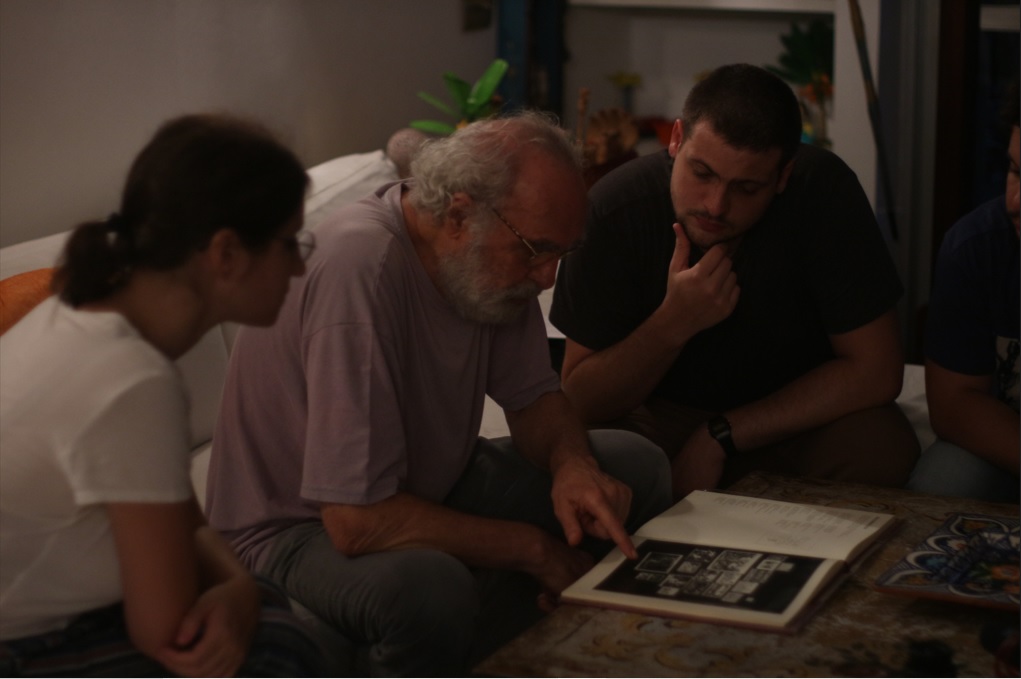
We arrived at his house in the early afternoon and as night approached, without us realizing it, the room became darker and Bressane’s figure almost indiscernible. From the other side of the room, we listened attentively to his voice. The lights only came on when he showed us one of his editions of Mnemosyne, the first to be published in Europe.
After more than three hours, we were still unable to talk about everything we would have liked, as our questions increased, leaving even more admired by his work and person. Fortunately, we were able to resume our conversation the following week, in a second part that will be published in upcoming editions of Revista Limite.
Introductory text by Matheus Zenom and Paula Mermelstein; interview conducted by Gabriel Linhares Falcão, Matheus Zenom, Paula Mermelstein and Vinícius Dratovsky; photographs by Vinícius Dratovsky.
***

Júlio Bressane: At the beginning of 1970, in January or so, at the old Instituto Nacional de Cinema, Jurandyr Passos Noronha and Humberto Mauro’s son, Zequinha Mauro, were showing and I watched about thirty, forty minutes of Limite. I didn’t know Limite, I hadn’t seen it before. I was very impressed by that, but at that moment, as I was doing a lot of things, I didn’t have any distance, I didn’t have any observations about that thing. And then, perhaps, this is more important for that reason, because once you see, observe and do, the thing is already dead. But I had a drive, let’s say, an optical unconscious, of Limite in Cuidado Madame, without knowing it. Many years later, fifteen or twenty years later, one day seeing Cuidado Madame at the Turin Festival, when they made a new copy and the film was shown – that was in 2002 or 2004, the film had been made in 1970 –, I saw where Limite had marked me and it was in this film. You observed [Note: Bressane refers to the text “Algumas considerações sobre Cuidado Madame”, by Matheus Zenom] and this was an observation that not even I had made at the time, I made it without knowing what it had to do with it.
A scene that impressed me most in Limite, and it was lucky, because the film lasted an hour and so and I only saw forty minutes, was a scene that it seems that Jurandyr himself later used in a documentary [“Panorama do Cinema Brasileiro”], I’m not sure, but it’s a camera movement that doesn’t exist in cinema until then. In all those films by [Marcel] L’Herbier, [Jean] Epstein, [Germaine] Dulac, [Abel] Gance, all of them who made those French avant-garde movements at the beginning of the 20th century, to which the Limite is a bit attached, not even in Russian cinema, that movement had been made, that audacity of the camera, which I said was when cinema configured the “sign of the Self”. It’s a shot that is the work of Mário Peixoto and Edgar Brasil, in which the camera in hand goes down the woman’s body, walks with her and then abandons her, goes away, over an empty road, through some barbed wires, a bush, and then returns to the woman. When I saw that, I was thinking that this didn’t exist in cinema, that I hadn’t seen a movement like that. And this is a movement that you [Matheus] observed and that you have in “Cuidado Madame”, of the camera abandoning the actors. I did this out of intuition, I never thought about “Limite” at that moment and I had that precocious vision, without being able to assimilate it.
Then, four or five years later, I made a film called A Agonia, which is, let’s say, a pastiche, a parody of Limite. I took some key shots from Limite and redid them there, but then already knowing Limite, already understanding those shapes. It was still unprecedented, as it is to this day in Brazilian cinema, but even so Cuidado Madame had a more powerful force, more pathos, more emotional, than later, when you had already mastered it, because it was such a strong thing that I didn’t notice. It was only later that I realized what was obvious. That was an observation that no one made and I found it very curious because we hadn’t seen cinema like that yet, cinema was still tied to history, the image had lost the primacy of the statement, history had taken that place, which is even today.
Matheus Zenom: These were the images that struck me most the first times I watched your films. At the same time, it’s still different from what happens in Limite because the camera continues and the character is the one going…
JB: There are two times, because there is this one where the person disappears and then comes back, but there is an interior where the actors are in a swimming pool and the camera takes a walk through the house and goes to an iron, inside a room. It’s something that deviates, but it fits not only into the rhythm, but also into a kind of domestic iconography: the duster, the hallway, the dishes and, finally, the iron. It’s their world, the maids’ world, there. And there’s that about the crowd, too, you’re right. Although it is an eleven-minute shot, the camera comes from the street, they enter an avenue and disappear into a crowd, the camera waits and they return.
MZ: What was it like to use the sequence shot in this way? Because it is quite different from what existed until then in cinema.
JB: Cinema began as a sequence shot: there were three-minute shots that were filmed in one piece. Then, when making the films, with Griffith and so on, we began to cut out, edit… Since my first film, I always had an intuition about the sequence plan. Since the films when I was still graduating, making my first film, I have always been attracted to long shots. Always, since always. Even in industrial, American films, full of two, three, four minute sequences without cuts. The sequence shot has always attracted me. The first film I made, a feature film, had a long, fixed shot, even. There were only panoramic movements, but it was a long three-minute sequence. Then, I made O Anjo Nasceu, which is exactly the saturation of the sequence shot: it is all filmed in long takes, which go at a rhythm that, in the end, extends to infinity, to saturation.
The sequence shot has something that will always interest me. Beyond the character, the story, the plot, what is there is the film. So, the sequence shot has this opening, it curves in on itself, it is a sign that sees itself. The main thing about the sequence shot is cinema, the evidence of the sequence shot. In a shot of three, four minutes, whatever it is, it is that extended duration that becomes the main thing and that is where cinema is. The sequence shot is a kind of self-referential shot, it refers to itself and this “self” is the film, it is irreducible. So, I’ve always been interested in this – not because of the length of time, but because of the duration of concentration, of tension over something.
I made a film last year, which is coming out now, called A Longa Viagem do Ônibus Amarelo, which is 7h20min long. There are 58 films that I made and they are there, in a chronological order that is broken by a ring, which I called a “Medal of the Flood”, of films about a leitmotif, which have a main motive. So, A Longa Viagem starts with the films from 66, 67, 68… and then there is this ring, with the leitmotif of the stairs, with scenes from eight or nine films in which there are scenes on the stairs. The ring that has the longest time is, precisely, the sequence shot: this sequence alone lasts 1h40min. Not all of them, but, in these 58 films, there are some sequence shots.
The sequence shot, on the contrary, is also very difficult because, precisely, it cuts out that unique thing about cinema that is editing: you only do in one shot what you could do in ten shots. In it, you have to make all these parts that are isolated come together. The sequence shot is like an ideogram, in which you put together several parts to form one thing: put the man, put the boot, put the house and it appears, has a meaning, which says “tranquility”. So, it’s a way of feeling the thought, the rhythm of it, how to make it in line with the feeling you have. It’s not like it’s a theory or anything like that, but a feeling that you have, where you realize that it would be better to do it one way and not another. This beginning also has, as a principle, as if it were a translation, the need for intuition; there is no rule, not even a technique on how to do this. In this sense, all these rules that, a priori, you must know, they must yield… and it is from them that this intuition arises. Making an entire film out of sequence shots because it’s better doesn’t mean anything, but finding this isomorphy between the background and the form is what raises the question of whether or not to use the sequence shot, using decoupage and so on.
I always admire the long shot and I also think that, in it, you allow more things to appear in the film. There is a much greater possibility of error than if you did everything under control and this possibility of error is what is important, this is what will create the pathology, it will give the artistic meaning to the thing. It is also the sequence shot that is capable of making you intuit what is outside the scene: in such a way that you are paralyzed here, at some point you leave the frame too, you emanate here, and that is what things begin, because what is in the frame has to be understood together with what is outside the frame. If you don’t notice what’s outside the frame, you have a partial understanding of what’s inside it.
Vinicius Dratovsky: You talked about the film you’re releasing now, A Longa Viagem do Ônibus Amarelo, and I’m curious to know how this came about, what you were looking for when you started, what the initial plan was.
JB: How something came about, how it appeared, it’s always difficult to pinpoint when you do something. But A Longa Viagem started a long time ago, around 2010, right after I did Cleópatra. Rodrigo Lima started to gather the material that existed from my past films and it was there that I started to have this idea, of bringing together all this material, around 80 hours, 58 films. There are only two films of mine that are not there, A Longa Viagem do Ônibus Amarelo and the one we just made, Leme do Destino. The films in it are almost anonymous. As much as my films are known, they are anonymous films: you know them and a few others, but they are films that have never been shown, for example. So, I saw it from a certain distance. My first film was made in 59, when I was 12 years old and I recovered it. It was 3 hours filmed on a 16mm camera and I recovered twenty minutes, ten minutes. I mean, I had all of this from 1959 to 2020. So, I was thinking how I could make a film with that material. How could a film be made of that? That’s when I started editing, seeing what those images had between them of something that could be separated from that whole. If the film is 1h30 long and you take two minutes away, things become distorted. The idea was precisely how these tropes, these common places, these figures of cinematic syntax, what existed there, could be used. We identified 27 figures, which are these rings, these Medals of the Flood: the close-up, the traveling, the camera movements. So, I made a film with these films, the history of a cinema, since Lumière – a concept of film, of image making.
In this, there is nothing biographical, as if it were a biography of you that you took from your film, it is nothing like that. It would be more of a biographeme than a biography. The difference is that biography is consciousness and memory, which you deposit and do the thing; the biographem starts from this, but it is more than that: it is entangled with fiction, memory and with other times. So, it would be a biographeme because there is nothing personal, intimate, authorial, there. In fact, A Longa Viagem is this thing: it has no plot, no characters; what is there is the film, what is “cinema” there – it can be good or bad cinema, but what is “cinema”, what is it reduced to, that is all the film, before anything else. So, it was something that I thought was important, not that it was a theory, what it could be. The meaning of the theory is what moves away; the theory is what you see from afar, God’s vision: you looking at your own films and reflecting, but that’s not it. These are films that abolish the author, they have no author, they have no character: there is the film! That’s what’s in those 7h20min, those are the films that are there.
The relationships, the interpretations, the intra-relationships, each one does as they see fit; I never intended and do not intend to give direction to anything. There is a poet and great German thinker who said exactly this, he considered that if you tried to direct the viewer’s gaze or whoever you were referring to, your work was useless, he considered that the first crime you could do to a work of art was this, wanting to direct your reader. So, what is there is the film, it is the cinema, as you can say the same thing about music, painting, literature: what remains is the writing, the painting itself, the musical silence. That’s what I thought and what made me do it was this struggle between power and inhibition. What drove this film was a desire to do it. Everything I’m telling you was thought after the film was made; while I was doing it, there was a determination, a desire to do it. After you do it, you see how everyone else sees it: it’s as difficult for you to understand what you did as it is for anyone else. Above all, it is doubly difficult because what you do and what is really strong may be visible to others, but for you it is invisible, because it is evident; It’s obvious, but you don’t see it. And you do it precisely in this sense of trying to understand something that you don’t know what it is. So, these films are made as you do something irresponsible, idle, without predetermination, and that you can also push the rope that surrounds you.
Gabriel Linhares Falcão: How was the trip that titles the film? Is that the trip you took with [Andrea] Tonacci and Rosa?
JB: At that time I lived in England, I went there in 1970. What was there at that time, in London, and which was arriving quite pasteurized, quite diluted, was a flavor of Eastern philosophy. All these practices from the “Oriental world” were very widespread at that time: Buddhism, food, yoga, breathing techniques, ideograms, all of this came to light in this English universe, in London and in other places as well. I had already made three films in England and, taken by that, Rosa started translating a book on Indian philosophy – I don’t remember now exactly what the book was –, but translating it at home, for herself. I saw an ad in one of those clandestine newspapers that ran in the neighborhood at that time, the Notting Hill Gate neighborhood, I saw an ad called “Yellow Bus”, a company that had some old buses, painted yellow, that ran from London to Darjeeling, on the other side of India, on a two or three month trip.
When I saw that, I thought it was a good thing, except for the part where you had to submit to traveling on a bus and having to stop here and there. And a great friend of mine, who I had known for many years, a wonderful man, a gentleman, a delicate soul, a very fine man, Andrea Tonacci, was in London and I said to him: “Tonacci, I saw an advertisement here, I’ll go over there to look it up. Let’s take this trip!” So, I went to Shepherd’s Bush and picked up the leaflet – which unfortunately I lost and would today be a treasure of information, the flavor of an entire era – which told everything, the route to take, the paths to take, what to find in every village like that, in Herat, in the middle of Afghanistan. In 1970, there was nothing, there were mud houses and nothing, it wasn’t even a village, it was a transition between the maloca and the village, but very old, people had lived there for millennia. All of this was very difficult and this booklet gave all the tips, where to find everything: “when you arrive in this city you look for a guy, who is an Austrian, who has a house, you stay…”, and with all these lost places of the world! When I saw that, I said “let’s take this trip here, let’s follow this advice”. It told about places where there was fake money, passports, drugs, whatever you wanted, there was a tip there.
Tonacci and I then went to Germany and he bought one of those Volkswagen convertibles, a spectacular car. In Hamburg, where the Volkswagen factory is located, there are several shops where they do everything in the car, they adapted it and put a bed inside it. Tonacci, Rosa and I slept together in this car for six months. So, we went out and arranged a meeting in Venice, and then it began. I took a 16mm camera and a super 8 camera with me and thought about making a travel film, something like that, kind of fictional. None of this unfortunately came out, but it was something like that to enjoy ourselves there, to go on a trip, but all fiction, all kind of “Nanook”, all staged and then done. But Tonacci convinced me of something else. At that time we were still in the midst of the influence of anthropophagy, of Oswald de Andrade, and Tonacci said: “No, let’s make a film about us eating” and I thought “I’m going to eat the entire East” [laughs] and that made the idea click, of filming us eating.
I started filming in Venice and then we went on with the entire trip, to Yugoslavia – today Serbia and Croatia –, a part of Albania, Greece and Turkey. From there we continued through Syria, Iraq, Iran, Afghanistan, Pakistan, India and, then, Nepal. I filmed all of this in super 8 and 16mm. An extraordinary thing because, despite being in 1971, 72, it was another world, really, in every way, in gestures, habits, architecture, another world. I filmed the whole thing and called it the “Yellow Bus Trip,” which is what we followed. This material, for a number of fateful reasons, was lost, it remained in a warehouse for many years in England and I only found it many years later. I recovered, but from the 3h, 3h40, which we filmed, fifteen minutes were left. Even so, what was left was important, because they are places, paths, monuments that no longer exist – the Buddhas of Bamiyan that exploded –, all of this we filmed. It’s a precious material because they are places that disappeared, people even, the upper part of Kashmir, where the war took place. So, I luckily saved some fragments of these things, which I only came to assemble and see many years later. That was the idea: it was a film without editing, with raw material that we filmed on this trip, which was in geographical order – it started from there and ended here – we filmed it in that order, so there was already that order, there was no need for editing, it was edited in the camera.
Later, when I took this material and put it together, I called it all A Longa Viagem do Ônibus Amarelo, because I transformed this trip into the journey of all films, the loss of all films, that’s why I called it “Medals of the Flood”. This is an expression created by Onffroy de Thoron, who wrote a book about prehistoric Brazil. He was a man who searched, throughout Brazil, for sites dating back to the 16th century, of prehistoric culture: caves, rock inscriptions, signs, stones, megaliths, mythical constructions, legends. He called each of these places he located “Medals of the Flood” and I found it appropriate because my films, in fact, are floods: something that no one has seen, they were made by my desire to persist and to survive, films that were carried away by the flood.
So, I called the entire film A Longa Viagem do Ônibus Amarelo as if the entire film were one journey, and that it begins exactly with one journey. In 1958, my mother took me to the United States, to New York, gave me a camera and a 16mm project. Even though I was still a kid, I really liked cinema and went to the movie theatre a lot. She knew I liked it, she gave me the camera and the project and I then started filming this trip. At the end of the following year, I went to Europe and filmed it too, for the first time. I started with travel films, all these films, between 59 and 62, that is, I was between 12 and 15 years old. This is repeated in the film, there are several travel films within A Longa Viagem: trips I took to Mexico, through Latin America, through Brazil especially. These are fragments, but it’s all in the film. Now, it’s a film that you have to be curious to see, in the sense of carrying out an optical excavation, because the montage I made of these films has no apparent explanation. There’s no date, there’s no sign, there’s no indication of whether it was in 71, whether it was in 94, so-and-so… There’s nothing. It is a succession of images, with the original film frames and phonograms, but some altered phonograms: sounds from one film to another, etc. So, this long treadmill has no explanation, the images succeed one another.
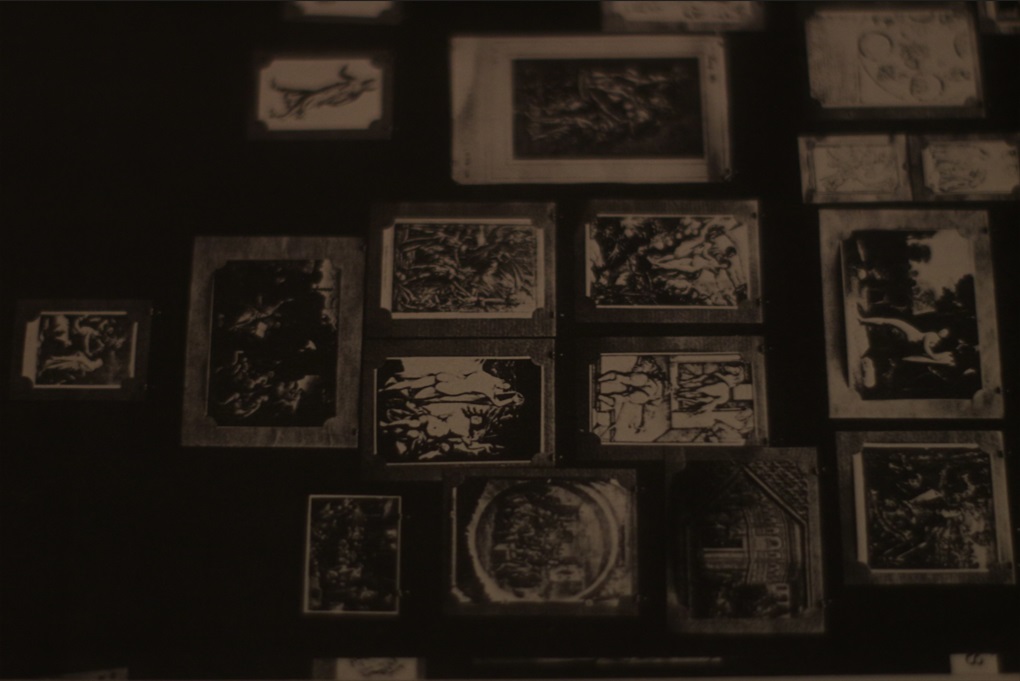
This was done before by a work infinitely superior to mine, which is a work by a German art scholar called Aby Warburg. This man made a book called Mnemosyne, which is a rigorous montage of images, the zenith of any montage in music, literature, painting, that has been made – human thought, montage, was this Mnemosyne. Now, it’s something that, in order to see, you need to be almost an exegete of that, because “why is this image put together with this one?”, in principle you don’t know why, what that is, and that is the logic of internal interaction between meaning and signifier that is very strong, which is the strength of his work. There are sixty or so black boards, on which he placed photographs of famous paintings in black and white and set them around a theme, which he didn’t say what it was. In the book I’m going to show you, there’s an explanation from the editor, who made a little map for you to follow: the editor! Warburg didn’t do that, he thought you should come here to understand what it was; the editor, who is a trader, showed “read it here” [laughs], which is a key for understanding, but it distances the book from its final project, which was precisely for you to pursue it.
These projects tend towards one thing that we all seek, which is to be the other. Nobody wants to be yourself, you want to be someone else. And these works force you to something that is self-transformation, which is impossible, man cannot transform. But, to understand that, you need to take a long journey to get there and it is this journey that transforms you. You only see what you know, so you had to go and find what this riddle is. That was the big lesson I took away from Mnemosyne. It’s Fernando Pessoa’s old excuse, which said: “It’s better not to make excuses than to be right”. So, Warburg doesn’t make excuses: he shows things and, if you really want to know, you have to go and look for it. In other words, it’s something a little pretentious because it forces you and maybe you don’t want to go, but for you to understand, it forces you to do it, like James Joyce’s Finnegans Wake. Today there is a library of exegetical texts on Finnegans Wake, they did everything, but it is a text that, if you are going to face it, takes time; There is a lot of literature that you have to go through to understand that process.
Warburg did the same thing, it’s a type of montage that forces you to move; you need to transform yourself, make an effort. That’s not my thing by far: it’s too obvious and I don’t have that kind of strength of thought like him, by any means, but it also forces you to understand it as a film, and not like many films that are out there assembled. Like a single body and, for that, you need to enter the film in another way and not just as a quote: “Ah, this is that one, this is that other one”. No. None of those are anything, all of those are what you see there, so far away, they are removed from the context where they were produced, even outside the emotion that produced that. It was made forty, fifty years ago and you don’t even remember what happened there.
It’s a film for which you must have this question of the need it, it’s not something made for you to understand. That’s precisely the difficulty, you might not understand at first. One of the most radical judges said that “everything you understand is dead”, that is, you have to be interested in the things you don’t understand and make them your own. In the 18th century, [Denis] Diderot said that there was a genre of painting that was made for the painting itself to be seen, without the need for the spectator. He went further, saying that any work of art made with the public in mind is a lost creation. These are radical positions, but they are not about excluding someone: it is precisely the difficulty of including someone. This is all for you to see that these are things you do today, but they are far from being new; They are new, but, like everything contemporary, they are linked to the new, because they are linked to yesterday. Everything now is linked to yesterday, the “already” is linked to yesterday, the “contemporary” is always linked to yesterday.
MZ: You said that you have films you made since 1959. That makes it more than 60 years of production. If I’m not mistaken, it’s the longest production in Brazilian cinema, isn’t it?
JB: Well, I’ll tell you: I didn’t want to get that fame, you know? [laughs] So many things, I wish I didn’t get that fame. But maybe. This thing is a bit of destiny too, you know? Things happen.
I was born here on Aperana Street, where I lived my whole life. My parents were separated, I was already a kid, four, five years old. The one who took care of me was my widowed aunt, my father’s sister, who was fascinated by cinema. As I had a very explosive family situation, for me the movie theatre was always a good place to go out and she took me there almost every day, we watched two films a day. Everything around here, we took the tram and such. So, from a young age, I began to become possessed by cinema, by the mystification of cinema, by the illusion of cinema. This ended up being good for my spirit, because I always lived on illusion, illusion was always an important part of my childhood and cinema helped a lot with that, to form the illusion in me, when I was a boy, six, seven, eight, ten years. This stayed with me and, perhaps, soon distanced itself from me. I started to see cinema as a thing, no longer as a product of those immediate emotions, of running away to see it. But little by little I saw that it was fulfilling other areas of being, other needs. Ever since I was little, I always wanted to, and as soon as I got the camera, I started to use it like it was done in the cinema, doing pans, camera movements, quick cuts, imitating… [laughs] So, cinema had already deformed me, there was already a distortion by cinema. Everything was something with a sense of need for me, to overcome some inhibitions, to be able to clarify some things that were difficult for me. Then I realized more clearly, cinema for me has always been an instrument of transformation.
I realized very early on the difficulty of cinema. I was an assistant on Menino de Engenho [by Walter Lima Jr.], I was an assistant on Viagem ao Fim do Mundo by Fernando Campos. The first film I made was about the writer Lima Barreto. I knew Francisco de Assis Barbosa a lot, his daughter too, and he had written a biography of Lima Barreto, at the end of the 50s. In 64, I think, he published a second edition, A Vida de Lima Barreto, that I still have there today. I read and bought all of Lima Barreto’s work, from Globo editions, I have it there, and I read all of Lima Barreto’s work and I read the book by Francisco de Assis Barbosa, who was a gentleman, a very educated man, very civilized, an academic. I read it here, I was fascinated and wanted to make a film about Lima Barreto. I went looking for the iconography of the time, the music of the time. A lot of people helped me, that was in 65, 66, I was 19 or 20 years old, especially in the musical part, Ary Vasconcelos was a man who was also very sensitive to me, he was a researcher of music from the beginning of the century and he gave me a lot of the huge repertoire that I used in the film.
I realized right from the beginning this issue of the film’s difficulty – later, in Cara a Cara then, it became quite evident to me – and that cinema was a kind of intellectual, sensitive organism, which moved to cross the disciplines. I saw that cinema crossed all of this, all the arts, painting, music, literature and even physics, chemistry, the laboratory. I realized this and saw that this was, precisely, a requirement of cinema that no one, or few fulfilled, I realized the requirement was to cross disciplines to understand where cinema is made, why cinema is made in these disciplines. The cinematic cliché is renewed across disciplines. If you don’t put the cinematic cliché in contact with other signs, it won’t change. All the influence comes from there, you have to clash with others, cross over. It took me a while to fully realize this, but I gradually went in that direction.
The next film from Cara a Cara were two films that I made together, they were Matou a Família e Foi ao Cinema and O Anjo Nasceu. But then it was a much more advanced step, because between Cara a Cara and these two films I spent time in Europe and there I saw many experiments of enlarging film from 16 to 35mm. I was interested in this because I made a connection between the photogram and this issue of light. The photogram, a film, is a paste that captures light, made of micrograins and each grain has a piece of light that will give it to the whole. Gance said “Cinema is the music of light” because of this, because in the transparent frame, which has nothing, it will create a shadow, which is the image and it is this shadow that orders the frame, that is, it is the music. So, I realized that the enlarged 16mm made the grain jump, which was what at that time the laboratories were trying to hide the most, to make it more similar to the 35mm, something that was absurd, precisely because it was the grain that gave this difference, it appeared the grain. In other words, you realize that the image was made up of grains, that each grain had a quality of light, it was another advancement within the film.
Something happened with these two films that was far beyond what I expected. I did both in 16mm and black and white. I revealed them. I had it expanded in São Paulo, which was the only place that did it, the laboratory. During this process of development, as it was very precarious, in 1969, the 16mm film was developed in what was called a “very used bath”, so it printed like dust on top of the negative and that was a disaster. When I saw that, I thought: “It’s over, I missed both films”. A head of the laboratory called me, I went and he said: “You can try to do something to reduce this dust, something we have never done here and we can try, which is to polish the negative”. This in itself is an aberration as a formulation, because polishing the negative means destroying it. [laughs] I thought I had already lost everything, so I accepted. They took a machine there, adapted it and polished it. It improved by 90%.
What happened and was unexpected, something that took the film away, but for me it was the best thing, because the grain stood out, that image was sprinkled with grain, you could see the negative. Especially at the end of O Anjo Nasceu, which is spectacular: that ten-minute image and just grains jumping there, the image almost falls apart. That’s what took the film away and, at the same time, that was the invention of the film, also by chance, because it was the polishing that took the dust off. So, I finished the films, edited them and had a very big surprise, because when I made these films I didn’t think about showing them, I thought about making them for us here, showing them at the Cinemateca [T. N.: Rio de Janeiro’s film archive in the Modern Art Museum], without really showing these films. But a man I knew who worked in cinema, an old man, he told me: “Look, I’m going to show this film to Severiano Ribeiro”. I knew Severiano, the father, who died, I was at a dinner many years ago where he was present, I was introduced, but I wasn’t even making films at that time. He, I don’t know why, agreed to see the film and saw it. He saw it and called me, Severiano Ribeiro called me, the front man for the American distributors in Brazil! He said: “Look, I saw your film, I want to release your film”. I was scared when he told me that, I was embarrassed! I said: “How is he going to do something like that…” [laughs] Well, he called me into his office, made fifteen copies of Matou a Família e Foi ao Cinema and released it in twelve cinemas here in Rio, from Leblon to Méier, throughout its entire circuit. I was in the middle of filming, in the middle of January 1970, I was involved in other things and I didn’t even think about it, but I received a phone call and they told me: “Júlio, the film has blown up. It’s getting a lot of attention” and I said “Really?”, I was a little scared, even a little embarrassed. He asked me: “Where are you?” and I was in Barra da Tijuca, doing O Anjo Nasceu. He said: “When you can, stop by Cinelândia and see it.” Matou a Família e Foi ao Cinema was showing at the Odeon [T. N.: traditional movie theatre in Rio] and I went. When I arrived, there was an anthill on the cinema door: Matou a Família e Foi ao Cinema and an anthill on the door. I stayed away and didn’t even go there, thinking: “My God, what is this?!” [laughs] I was embarrassed about that thing, I don’t know why.
Ribeiro was going to make twenty more copies to launch in São Paulo and launch it throughout Brazil. The head of Brasília’s censorship entered the Odeon and removed all the copies; With the police there, he took the copy from the projector and put it on the door: “Banned”. And then, they banned the film all over Brazil: this film was banned for twenty years! Matou a Família e Foi ao Cinema, in this film, no one’s elbow appears, there’s nothing. It was a cold shower, but I continued filming. Ribeiro called me and said: “Look, I heard that your film was arrested, so let’s make another one”. A capitalist, a very rich man, asked me to do another one! I said “Let’s go”. [laughs] And then I went to his office, on Rua México, on the sixth floor, where you had to take the stairs and he said: “Let’s do this, make another film now”. I got a contract and wrote a script called A Divina Dama: Eu Amei Greta Garbo, “a film with Grande Othello”. I gave it to him and, right away, he gave me the negative and the money to make the film. I was starting Bélair, which was a smaller thing: I was going to make one film and Rogério [Sganzerla] was going to make another. But, with Ribeiro’s contract, I called Rogério and said: “I have a contract here, with this we are going to make five films” and then we made six! We took the negative, divided it, with another part of the money we bought a 16mm negative, I made one film and he made another… I went to Ribeiro and told him: “Instead of delivering one film to you, I’m going to deliver six” and He accepted right away, he didn’t even want to know, he said “Great!”. He had released Rogério’s film, The Woman of Everyone, which had even made money here in Rio.
With that, we created Belair, which already existed, but expanded. It was done and closed, because, at the height of Belair’s business, when we were going to expand the business, there was an a priori ban on films. We were framed under the National Security Law, they said the film was made with Marighella’s [T. N.: a Brazilian leftist militant, very important in the resistance against the military dictatorship] money… With Matou a Família e Foi ao Cinema they would have created a curtain, like, of terrorists and such. We left Brazil, the films were never released, Ribeiro accepted, he saw that it wasn’t our fault, that it was the circumstances. Belair became very famous and incognito, not one Belair film was shown, out of the six films. So, these are stories of “Medals of the Flood”, of things that were made but were not circulated. It went missing, and this would be the work of some sociologist or anthropologist, to study why it went missing, why these films were not shown, what happened there. This study was not carried out. The history of Brazilian cinema ends in 1969. After the emergence of Belair, no study was carried out, because, to carry out this study, they needed to revolve the past and this is a taboo, even today. Studies only from the 80s, or the 70s, classifying these films as “underground movement”, “experimental film”, things like that, all of this to avoid discussions about the films. Until today. There is no distinction between one thing and another.
MZ: At the time, did you show these films at festivals? Because you left Brazil in 1970, right?
JB: No, not at the time. This thing was so macabre, it involved such a political fight… I’m going to refrain from talking about it, I’ll leave it to a sociologist, an anthropologist, if someone ever wants to do it. But, with this rupture, I spent almost twenty years without presenting a film at any festival outside of Brazil and, here in Brazil, fifteen! Brasília Festival, Rio, everyone refused these films, until the 90s, and in Europe too. My last film that was screened was O Anjo Nasceu at the Cannes Festival, in the Directors’ Fortnight. From 1970 to 1992 none of my films were screened at any festival, they were rejected from all festivals. There was an iron curtain that prevented you from arriving [laughs]. In 92, I don’t know how, this spell was broken by someone who saw Brás Cubas at a festival in Italy, I think in Salsomaggiore, I’m not sure, and called me. That was in 88, 89. I thought it was a prank call, I almost hung up. An Italian said to me: “We watched your film, Brás Cubas, and we wanted to know if you made other films.” They said they really liked the film. I didn’t even know that the film had gone to Salsomaggiore! Embrafilme, at the time, made a copy, sent it there and didn’t tell me. The film was released here over a weekend and taken out of theaters. Two or three years later, the director of the Taormina Festival, Enrico Ghezzi, called me and asked if I had any films to send there. The last film I had made was Sermões, in 1990. I sent the film, went there, presented it… that’s when it opened. From then on, I was invited to several festivals, until in 2000, 2001, there was a big retrospective of all the films I had available at the Turin Festival. Since then, I’ve had traffic at several festivals, much more than I ever imagined. It was something that happened, that I didn’t expect and that was fortuitous.
VD: It was in the 90s that your films became known, then.
JB: It was a kind of reunion of time. Then they passed on the things that had been a little lost.
MZ: During this period in the 70s, you went from Rio to Paris and from Paris to London, right? You said you made three films in London, can you talk about them?
JB: We left here in March or April 1970. I took the negatives, not yet developed, of Cuidado Madame and Sem Essa, Aranha from here to Paris, with the sound tapes straight from Nagra. In Paris, I went to the Éclair laboratory, where we made all the films: we developed the negatives, edited them, mixed them and made copies. The negative is still there today. When, in 2000, the Turin Festival had a new copy of Cuidado Madame made, I was impressed because the new copy was better than the original, a perfect copy. In this, the French are brilliant, they have a preservation there that is spectacular. Well, we finished the films and, at that moment, we were going to make other films there. I was going to make a film called “SOS Brasil” and Rogério had two projects: one called O Rei dos Ratos and another that was an adaptation of Marighella’s Manual do Guerrilheiro Urbano – which would have been a brilliant film, there was a void there and this film would enter into an extraordinary political discussion, much more than Costa-Gavras, than Bertolucci, it would enter with spectacular force. But, due to yet another one of those ironies and malfunctions of the past, this did not happen. The agreement we had to sell films with a French merchant, due to malicious intervention, did not come to fruition, and we were left without the money. We were going to make the two films with 75 thousand dollars, but it didn’t happen. And not even what would be the fate of both Cuidado Madame and Sem Essa Aranha which was to enlarge both films to 35mm, to release them there. None of these things were done, the films remained in 16mm.
As a result, we were invited to go to England. Caetano [Veloso] was there and one day he called his manager, Guilherme Araújo, and they asked us to go there, Rogério, Helena [Ignez] and I. We went. That was in June or July 70, we had already finished the work. I stayed there for a short time, went back to Paris and one day, again, Caetano called, spoke to Rogério and invited him to go to L’Escala, on the Spanish coast, near Barcelona. I had rented a house by the sea and we went there for a month or two. Returning from there, I went to England. I saw that it was a good time to stay there, so we rented an apartment and I stayed. I started dating and living with Rosa and we stayed there for three and a half years. At the end of that first year, I met a photographer, a great English photographer, who was older and was retiring, and in a conversation I asked him if he wanted to photograph a film that I wanted to make. I used to go to a movie theatre there a lot, called Electric Cinema, a spectacular cinema, a kind of cinematheque, where they showed films from seven at night until seven in the morning. We stayed there all night watching movies, taking acid… I saw a retrospective there of English and foreign films with the strangler theme. In one of the films, it was very interesting that the lens was called “Strangloscope” [laughs].
That stuck with me and I decided to make a film with those clichés of the strangler film, I wrote a script called Memórias de um Estrangulador de Loiras and went to call this photographer to make the film. He was retired and was very nice to me, he recommended me a professor at the University of Kensington, Laurie Gane… great Laurie Gane, fate smiled on him. I spoke to him and he immediately said: “You don’t need to do anything, I have a negative, I have a camera, I have everything”. He was a teacher there, he had a room covered in 16mm negatives, which they bought by the ton. He was, indeed, another very delicate man. He had a brand new camera and made a light table… all of this was lost because the negative was burned, a copy of a copy was made, that is, something else was gained, but the quality of light was lost. I had a friend, Brazilian, who was Joseph Losey’s secretary, who was making a film in England called The Go-Between, with an actress who had become very good friends with some Brazilians there, Julie Christie, she was a famous English actress in that time. At the time, he invited us to go see the shooting, outside of London, I don’t remember where it was, in a castle. We went to see this shooting, Losey was there, he introduced me, and there was a production there… and I saw, in the filming, that there were about twenty girls in the audience, all blonde, and I told a friend who was there with me, Marcos, who died: “Take five of these blondes and let’s make the film”. They were extras from The Go-Between! [laughs] He called, the girls agreed, they went to London and in seven, eight days, we made the film, which was a repetition of the same thing: a man who went out to strangle blondes. It started with one, went to two, three, until there were ten at once. That was the film, a rhythm of crescendo and exhaustion.
I made this film and spoke to Laurie Gane, who was a young man, a teacher – which, like everything in England, was a modest profession – and lived in a place a little far from London, I asked him to make another film, which I called Amor Louco, Crazy Love, which was the name of a book by Breton and also of a famous American song, Crazy Love. Then we made the film in black and white, a brilliant black and white photograph. He took French and English avant-garde films from the beginning of the 20th century and made a black and white photograph, 16mm, on top of that, a masterpiece of photography – which has still been preserved a little, there are some good excerpts in A Longa Viagem. We made this film and then I went with Rosa to Morocco and there I made another film, called Fada do Oriente. We rented a house in the south of Morocco, in a place called Taroudant. We stayed there for three, four months. In fact, I didn’t rent it, I bought the house and then the guy gave me the money back, as if it was rented. [laughs] Another world, another time, a world that disappeared.
All these films depend a lot on the era, they depend a lot on the medium in which it is made. The habit is the straitjacket of the time. We live according to a habit, we have shorter or longer hair, shorter or longer skirts. It’s the habit that makes you stay the same or more or less. It’s almost impossible to get out of the straitjacket of an era. All these films had to do with that spirit of the time. Today something else survives in there, but what led us to do this was also the spirit of the time, this desire to be someone else, to not want to be yourself, to try to get out of yourself, out of your insufficiency.
After Fada do Oriente, I came back, developed the film, edited it and went to the United States, in 1972. I spent six months in New York, where I made a film called Lágrima Pantera, which was based around our time there and the place too. We stayed in a loft that was Hélio Oiticica’s studio, who at that time wasn’t “Hélio Oiticica”, it was Hélio, who took a loft where there was nothing, everyone there living on an almost starvation regime, and with some wooden crates, which he took from the Museum of Modern Art or in a storage room there, he made what he later called “Nests”. That atmosphere, the people who visited there, there was a brothel downstairs with these Puerto Rican girls, these black Americans… it was a very permissive atmosphere, very permissive at that time. There was a nightclub in front called “The Mud”, which was something that only existed back then, today it doesn’t even exist anymore. [laughter]
Then, I went back to London, assembled these films, put them in a chest and sent them to a warehouse. That was lost, in 72, 73, or so. In ’82, I said: “It’s not possible that this was lost. I’m going to go back and find this.” This happened because I found among my papers a little receipt for the deposit, in the Thames. I got there, showed it to the guy and he said: “Look, you’re late, everything that was here went to another warehouse, there’s nothing from that time here”. But I looked and thought that was an exaggeration, the deposit was too big for everything to have gone somewhere else. I asked where the wing marked on the ticket was, he told me, I went, the chest was there and I recovered all these films. These were the films I made there: Memórias de um Estrangulador de Loiras, Amor Louco, A Fada do Oriente and Lágrima Pantera. Then, I took this trip on the Yellow Bus and came to Brazil in October 73.
When I arrived here, the following month I made a film, O Rei do Baralho, with Othello and a spectacular woman, a brilliant actress who ended up not flourishing as she should have, Marta Anderson, an actress with the talent of Marylin Monroe, not because of physical resemblance, but for that unconscious talent. I went with Rosa to watch a revue play, near Lapa, on that street where the Teatro Rival was located, there were several little hellholes there. We went to one and Marta was there, she did some strip tease shows. When I saw it, I thought: “This is going to be the actress in the film”. I invited her and she was paired with Othello. She was really brilliant, but she disappeared as an actress. I did O Rei do Baralho, then I did O Monstro Caraíba and then it went on…
My time in Europe was like that. A lot of renovation and also a lot of difficulty. Today, speaking like this, it seems that all of this was coming out easily, but everything was the result of a mixture of suffering and a lot of difficulty – but the obstinacy, the will and the desire were stronger, so I managed to play this thing. All the films, from the last one I made to the first, were all very difficult to make, like production, everything, I never had any ease in production.
VD: Of these films you made, was A Fada do Oriente also recovered?
JB: Yes, it’s in A Longa Viagem, a good part of it. It was almost entirely recovered, because it was filmed in 16mm, black and white, and suffered little negative fading.
I told you about the man who “fate smiled to” and never told why, he was Laurie Gane. Laurie was a teacher, a very sensitive boy, a wonderful person, an Englishman of a rare breed. Five years ago, six years ago, he read a second-hand text, a kind of biography of Nietzsche, made a story and gave it to someone else to draw a story in pictures of Nietzsche, and published it. It sold eight million copies in England, twelve million worldwide. He became a millionaire, just from copyrights. He sent me a photo of a house he bought in Wales, a spectacular house on the edge of a cliff, and he said to me: “Come here any day you want, this is the most wonderful place in the world.” . He became a millionaire with a comic book, a Nietzsche comic book! How absurd! [laughs] The biography he read must have sold two thousand copies, at most! [laughs] So, I mean, fate smiled on him, a boy who lived in London with great difficulty, with a motorbike that was always breaking down, ate fish and chips there… despite that, never with a grudge against nothing, always smiling. He got rich off a Nietzsche comic. When I saw that, I couldn’t believe it. I showed it to Rosa and she didn’t believe it either. [laughs]

VD: During the time you were in New York, did you come into contact with the experimental, avant-garde films scene that was happening there?
JB: No, I didn’t meet anyone in the United States or in Europe. People I knew from cinema were old people, with whom I had relationships, two or three film directors that I knew early on, but no one in the United States. When I heard about Jonas Mekas, I had been here for many years, I didn’t even know who he was. I mean, I knew, but I never looked for anyone, I never had contact with anyone in filmmaking, nothing, nothing.
Paula Mermelstein: Did you have any contact with people from the arts scene?
JB: In the arts, I met some people. I knew John Cage a lot, I was with him many times, I took Arto Lindsey and Rosa to his house twice. I met Merce Cunningham. I met a great sculptor, a very good friend of Cage, who made her works with material she found on the street, Louise Nevelson. A woman who was also lucky, married a banker and the guy said: “Do whatever you want”. I once asked, “Where do you get this stuff?” and she: “In the trash.” And she’s married to the millionaire… [laughs] I met Barnett Newman. I didn’t know him personally, but I saw a lot of works by Jasper Johns, Pollock… it was an overdose of Pollock. I got to know this artistic side a lot, that modern art thing. I met Ellsworth Kelly. I knew a lot of these people, but no one in cinema. The person who photographed Lágrima Pantera for me was Miguel Rio Branco, who was a photographer and had never made a film. I called and he made this film, in black and white and color.
Lágrima Pantera is Sousândrade’s verse: “tear / panther”, the two images of fear, of trepidation. I made the film as a montage of two panthers. I set up the “Nest” and the people around it; shadows and graphic design. Making it as if it were a montage of words. A strange montage because “tear” and “panther” are two difficult words to put together. Augusto dos Anjos has a verse in which he talks about “ingratitude”: “Ingratitude – this panther –”. One thing close to another, a dangerous thing, both the “panther” and “ingratitude”; both the “tear”, which is something you do in a moment of euphoria or pain, and the “panther”, which is something that you, naturally, should be afraid of. So, I created a montage as if they were two words that met, using cinema clichés such as shot and countershot: a shot in black and white and the countershot, with the same action, in color. Not the same plane with a turn, but different planes. It was like that. I added some things, some scenes with ambient shots. There’s a big sequence shot there too, which is a kind of crime reenactment, revealing the place.
It was a time to listen to a lot of music, there was a lot of old stuff that was still alive there. I listened to a lot of jazz in the 70s, when rock bands were all at their peak, Grateful Dead, that kind of thing. I listened to the great jazz musicians, Thelonious Monk, Miles Davis… one who even stayed with our friend, invited us to go to his house, Art Blakey, drummer. Milt Jackson. A lot of old jazz musicians were still kind of taking a last breath there, playing. A drummer from the 30s that I knew was Cozy Cole. Max Roach. I watched all of this in England. We met Monk, Rosa and I went to talk to him. He couldn’t speak, he was snoring, but he couldn’t speak. We met all these old musicians and also the new bands that were there, especially the Grateful Dead, Led Zeppelin, Jimi Hendrix. He lived two houses away from where I lived, but I never went to see him. I couldn’t go to the show he gave on the Isle of Wight because I was in Spain and couldn’t get out there, but I listened a lot and really liked Jimi. Of these modern music songs, it’s by far what I’ve heard the most and what I liked the most.
At that time, there were a lot of things that were coming to culture, it was a time of a certain rupture in behavior too. Your generation, João [Batsow, Júlio’s grandson], you are not even my children anymore, but my grandchildren, there are already two generations. There was a change in behavior, in social acceptance. Today you have another type of rupture to make, not like the one at that time, in customs and personnel. All of this remains, but today there is another horizon of rebellion.
PM: When you talked about Aby Warburg, I remembered an interview in which you talked about Manet’s Le Déjeuner sur l’herbe and how there was a shift there about placing an engraving within the painting, and how you wanted to do something similar in Cleópatra. I was thinking about how this also applies to several of your other films, not only in terms of this displacement, but also in the way the characters look at the viewer. In Garoto you redo the painting and it seems that the character is always not only looking, but also talking to the viewer.
JB: Warburg had an erudite reading of Le Déjeuner sur l’herbe. Manet himself hid it and Warburg saw from where Manet had not only observed, but copied Le Déjeuner sur l’herbe, which is from a Greek sarcophagus that Raphael saw in a Roman copy in a cardinal’s garden and made a copper drawing of this sarcophagus. One of Rafael’s main disciples – there are two of them, Marcantonio Raimondi and Giulio Romano – Marcantonio Raimondi took this metal copy and made an engraving. This engraving became famous because all painting studios – at the time when studio painting existed – copied this drawing as learning, which is precisely the Judge of Paris, which is a judgment on beauty in the Western. It is Paris’s choice, his judgment of the three goddesses. Marcantonio copied an essential but marginal detail from the sarcophagus.
This story is as follows: there is a banquet that Zeus gives to the goddesses of Olympus. One had just been expelled, which was Aphrodite. The goddess of discord, Eris, during the banquet, takes a golden apple and gives it to Zeus, saying: “I want you to give this apple to the most beautiful goddess at this banquet”. Zeus was in a difficult situation, because whoever he gave this apple to, the other goddesses would turn against him. He calls a messenger, Hermes, and tells him to go to Mount Ida, near Troy, to look for this hunter, this forgetful shepherd – who is a prince, Paris, who was expelled from there – and asks him to decide which of the three is the most beautiful. The goddesses, when they know this, fly there and Paris then asks them to take off their clothes, because the truth can only be seen naked. They take off their clothes and he asks each one what they could bring him. Hera, the goddess of air, organization, administration, offers this to him. Athena offers wisdom and Aphrodite, when it is her turn, promises that that night, he will have the most beautiful woman in Greece, Helena, in his bed. Paris then asks what’s good about Helena and Aphrodite, who only had a ribbon around her waist – the cestus, a ribbon that was used to prevent incestus: whoever had the ribbon could not be possessed by anyone in the family, when it was common for this to happen – take off the tape and show the organs. Paris then gives her the apple. Later, Freud interprets, from this episode, that you only find beautiful what gives you sexual pleasure, the interpretation he gave about beauty in the West, starting from the Judgment of Paris.
In this engraving, the water that falls from Mount Ida is the same water that will bathe Troy. When this judgment takes place, Aphrodite receives the apple and returns to Olympus, returning to being a goddess. So, this water that dominates the mountain and supplies Troy is guarded by the river gods and it is from this image of the river gods that Manet takes Le Déjeuner sur l’herbe. This design was copied a lot in ateliers and Manet was a frequenter of ateliers, he was from Thomas Couture’s atelier, he was a man of the atelier. Manet took the image of the three light gods and an androgynous woman looking at the sculptor, and placed it within the French landscape, in a woodland. This is the arch that Warburg established, where the first formation of Le Déjeuner sur l’herbe comes from, which comes from a Greek sarcophagus. Warburg sees how this crosses all times in painting, what is called a “dialectical image”, that is, from where far away it came to here, the many distant times in which it survived, at each interval a survival. He goes all the way to “Le Déjeuner sur l’herbe”. And Manet gave the wrong clue so they wouldn’t catch him. When they came to criticize him, when the painting was rejected at the Salon, he said that there was nothing new in it, that showing two naked women in a forest was a Renaissance thing, that it was a painting by Giorgione from the “Concerto Campestre”, which has two naked women and two guys, but it’s completely different from the one he copied. [laughter]
That is the question. Survival occurred in Manet’s painting as it did in all the paintings that you, in some way, reproduced. Like what comes out of a painting with oil paintings, static, later turns into a moving film. This is a transposition. What happened with Manet’s painting happens when you make all these relationships with some pictorial formation on another support. This Le Déjeuner sur l’herbe thing is very important, because that was exactly where Warburg gave the key to these two essential things in all art, which are survival and interval. Survival is structured in the interval. The first thing is here, the second is there; From then on, there was an interval, so this new survival was structured, the gesture went from one thing to another. This has been going on forever and Warburg located the first footprints that come here, what Walter Benjamin calls a “dialectical image”, a distant thing that reaches now and that you are able to see this trajectory of multiple times as if it were a constellation in which each star is located at a different time.
[Bressane shows us the first edition of Mnemosyne and comments on some of its plates]
JB: This is all a very complicated montage. One image is next to another not always for a visible reason, but an implicit one. Warburg had a generous belief in people, he believed that, in addition to this montage, there could be others. Imagine, no one even managed to get to that one, imagine the others. But he believed in the man. It was a false belief, but he believed that man was possible, could be sentient or something, something he is not.
Warburg included the controversy here as well. He found the same typology, between Le déjeuner sur l’herbe and Rafael. The same position, the same arrangement of bodies. But he discovered it earlier and also inserted here what appears to be another copy, in a 17th century Dutch painting, which also has the same motif. Everyone has the same motif of women in a field, but this one, by Giorgione, was the detour that Manet wanted to make. It’s the same reason, but the arrangement of the bodies is completely different. As people, to this day, are more attentive to the plot than to the thing, Manet gave the plot: “two naked women in a field, with two boys – that’s Giorgione”. Yes, that is the motif, but it is not the same thing. To this day, one always observes the intertwine, the plot, the story, when in an image this moves into the background; the foreground is the landscape itself, which is nature directly, without transparency.
In Mnemosyne, there are all kinds of image associations, around the question of gesture. Warburg saw that the gesture of a golf champion, with a club, is the same gesture of the maenad, when she is going to cut off a head. He took Darwin’s book on features and put together the same gestures, prehistoric gestures that have survived to this day.
It got to the point where, in the end, he made one that was contemporary. There was a time when the Vatican made an agreement with Mussolini’s government, which would give the land to the Vatican, but the Church would have to give up spiritual control over the people, and they accepted this. Warburg thought this was the destruction of the Church, saying that no earthly power would ever have the strength of a spiritual power over anyone, that is, spiritual power existed since man existed, from when he was afraid of thunder, until today, while the power struggles are always an episodic thing. So, Warburg placed all the photos of the Vatican, the columns, and the signing of this contract that the Vatican made with Mussolini’s government. Below, in that same Mnemosyne, he placed a newspaper report about a train disaster, with a photo of one of the survivors dying and asking for a priest, according to the headline. He placed it inside Mnemosyne, showing “This is what the Church is missing”, that is, the man at the time of death, at the end, calls a priest, so he had spiritual strength within him. This is what the Church is giving up for the sake of land.
Warburg went all the way with this thing. This combination of Le déjeuner sur l’herbe is the most visible, but it makes associations that are more within the language of the image, even showing the connection between rhetoric and the image, because everything you see is something you know and, if you know it, it is through rhetoric. It was rhetoric that created figures of syntax, all figures of speech were created by rhetoric, and the same thing in painting. Some things are not there, but they are in the language of painting. So, for example, the subject does not appear asking the priest, but along with the word it shows what is being lost there, it is something that is not in the image, but is related to it.
So, this is a big conundrum. As old Fernando Pessoa would say, it’s a “syncopated riddle, which no one in the circle deciphers in provincial evenings”, you know? [laughs] This is very difficult and requires reading, a lot of images so you can get into the assembly of each one, why something is there, what connects one thing to another. There is not just one thing, there are many things, there are many suggestions, many relationships, intra-relationships, almost infinite.
GLF: When did you first come into contact with Mnemosyne?
JB: Warburg was translated to the West in 92, the Florentine Essays came out in French. I read in Magazine Littéraire, a French magazine, an article about Warburg, I don’t remember who it was, I think it was [Giorgio] Agamben. He was doing research in the library in Paris about Benjamin and found some things there from Warburg, who he didn’t even know who he was. He copied it and an edition was made in 92, 93, with the Florentine Essays. I saw a previous mention of this work in Magazine Littéraire. I was doing the Sermões and I was very impressed with it, so much so that I’ve already looked for some things like that, like the reproduction of Venus, but it was still in its infancy, because I didn’t know the thing yet, I just had an intuition. That was in 88, 89. To be able to understand this, I read about ten books about it, because straight away I had neither the conditions nor the culture to understand it. But I read Edgar Wind, [Erwin] Panofsky, [Raymond] Klibansky, Fritz Saxl, Gertrud Bing herself, Warburg’s secretary, who was the woman who saved it from there.
So, I read all these people, taking tips from how they read this Mnemosyne project, which he didn’t finish. He had a heart attack in 1929, he was going to give a big conference to show Mnemosyne within a seminar he was giving on Renaissance culture, but he died. Warburg had a curse, because he was a very rich man, his family was, until today, a family of bankers, one of the most powerful banks in the world, the Warburg Bank. He abandoned it and left the financial responsibility to the other five brothers, as long as they paid for the books he bought. He built an extraordinary library and kept doing it, until he did that. He understood this montage to be a philosophy, a history of thought without words. He prepared 79 of these boards and died. He was very rich and bought a hotel in Rome, a three-story hotel, and settled there. His office had forty thousand books.
What changed Warburg’s life a little was that he came to America in 1896. He made a trip to the Hopi Indians in Mexico and there he changed his mind. When he saw that, he said: “The Renaissance begins here”. Then he made this library, because he was very impressed with the serpent ritual, and he saw the houses of the Hopis, who lived in the desert, in some rocks, some holes, and in one of these holes there was an orifice and, underneath, there was a kind of courtyard enclosed within the stone, which were the altars. He was very impressed by this because wherever you sat, you saw the entire altar, as if it were a horseshoe. He built his library on the same model, where from one point you could see all the books, which were sixty thousand when he arrived in England. Now, they were on shelves and he thought that, in each era, a book should be on a different shelf: for example, with a biology book from the 16th century, he thought that today it was an important book of poetry, so he would take it out of the biology section and put it into poetry. He made these montages.
This was a very serious problem, because it was an expensive library, where you had to have a telephone system to guide people on where to look for things – something that Ernst Cassirer, when he went there, was very impressed with. So, when Warburg finished the library and died, Nazism took over Germany and it was certain that they would go there and destroy the library, him being Jewish. Warburg’s family, knowing what was there, bought a cargo ship and adapted it to transport the library, put it on the ship and sent it to England. A month later, the Gestapo went there to look for where the books were, because they wanted to burn everything; They found nothing left and destroyed the inside of the building. This material arrived in England during the war and it was not yet known who Warburg was, then an eccentric, crazy millionaire, who had spent six years in the asylum in Kreuzlingen, as a patient of [Ludwig] Binswanger – Binswanger’s uncle was the one who took care of Nietzsche .
So, Warburg was considered a millionaire, erudite, he had sixty thousand books and no one knew what they were for. They took it and put it inside the library at the University of London, it was parked there for thirty years. At the end of the sixties, the university, with England already more recovered from the war, decided to carry out an investigation into what those books were and discovered that Warburg’s library was larger than the university. So, they said: “We can’t put that there; on the contrary, we are the ones who have to go there.” Later, they, together with this Courtauld, made “Warburg and Courtauld”. Not long ago, a few years ago, I heard that they were going to close the Warburg library because there were no more students. It was expensive maintenance, because there are a lot of books, it requires an entire refrigeration system, telephone communication, and there were no students. It has an art studies production that is the largest in the world, the largest art studies center in the world is there. Edgar Wind was the one who took care of that, Warburg’s greatest disciple is Wind. Nobody is interested in this, these are very difficult studies to carry out, so it’s kind of abandoned there.
MZ: This issue of the rhetoric in an image, which you comment about Mnemosyne, reminds me of something you did and which I really like in Brás Cubas, which is the “necrophone”.
JB: The “necrophone” is an interpretation of something I had done before and that, all three scenes before the “necrophone” are in A Longa Viagem. These are scenes that I did in a film called Viagem Através do Brasil, in 74 and, later, in 75, in Machu Picchu. It’s the principle of looking for sound where it no longer exists. I did a scene with the microphone passing through a rock on top of the rock signs, because you know what the sign is and even the meaning it may have, what we don’t know, and that is lost forever, is the sound of that, what was that sign called? That no longer exists. The “necrophone” is a bit like that. Do you remember the beginning of the book, “To the worm that gnawed at the cold flesh of my corpse”, that is, it no longer has a voice, the naked skeleton remains there. So, that’s why the “necrophone”, the microphone goes down to look for the sound where there is no more sound, there is no more voice, it is a skeleton. It didn’t die completely. Lacan has a thesis that says that man only dies when his bone is finished: the last stumbling block of the name is in the bone. As long as you have his bone, you are also alive. The last stumble that his name suffers is in the bone. After the bone, it’s over. So, the microphone goes down to the bone, the skeleton is still there, but the voice is gone, that part is gone. So, this is the idea of the “necrophone”. It’s an idea by Machado de Assis and, precisely, it’s at the beginning of the film, because he puts it in the book’s epigraph, “To the worm that gnawed the cold flesh of my corpse, I dedicate these nostalgic memories”. So, it’s something that is no longer there. This is the interpretation I made in the image and I created this image of the “necrophone” to translate this untranslatable thing, which is Machado de Assis’ text, to suggest something that is untranslatable. This is the question of the “necrophone”.
Rio de Janeiro, April 23, 2023.
 LIMITE
2 comentários em “Conversation with Júlio Bressane (part I)”
Os comentários estão encerrados.